As representatives of many nations and members of civil society from around the world prepare to gather for COP30 in Belém, the competing worldviews of various participants are clearly in view. Representatives of the United Methodist Church will be there, informed by our common faith. The Community of All Creation section of our United Methodist Social Principles offers a faithful understanding of God’s creation and our role in it:
“We affirm our sacred calling to be responsible stewards and to lovingly tend all that God has wrought. We recognize the inherent worth of God’s creation, celebrate earth’s abundance and diversity, and, along with the entirety of the cosmos, give praise to its Creator. We recognize we are interconnected members of complex ecosystems, intricate webs of life, all of which have their origins in God’s gracious act of creation” This section of the Social Principles goes on to affirm that “the traditional wisdom found within Indigenous communities, particularly the emphasis that native and first peoples have placed on living in harmony and balance with the earth and other animals as well as the need to protect the air, land and water.”
This perspective, which upholds the inherent value of God’s creation and emphasizes Indigenous wisdom, is at odds with the “conventional wisdom” of the dominant worldview. This conflict is apparent at international climate conferences. Market-based approaches to climate action take priority because the global economy continues to revolve around fossil fuels, which are highly subsidized even as solar, wind, and other renewable technologies become more affordable.
To add to the problem, ExxonMobil, Chevron, Shell, and other oil companies undermine international climate conferences because their executives often participate in the negotiations as official delegates and as lobbyists. Records show that 1770 fossil fuel representatives were at COP29 in Baku last year. Their undue influence continues to prevent strong international climate action. The demands of the Kick Big Polluters Out Coalition, which represents hundreds of organizations, includes calls for no corporate sponsorship from polluting corporations, an accountability framework, and action to protect against the commodification of nature, particularly safeguarding the Amazon rainforest.
Another example of the dominant worldview is exemplified by promoters of geoengineering, carbon capture and storage, and other profitable “after the fact” technologies. These so-called “Plan B” approaches to climate action supposedly solve the emissions problem and will allow us to continue using fossil fuels. Indigenous groups and other climate justice proponents say that these are false solutions and instead call for the “Plan A” approach of phasing out fossil fuels, funding loss and damage, and moving toward a just transition to a clean energy future. The Hands Off Mother Earth Alliance, made up of Indigenous organizations, frontline communities, and climate justice and human rights advocates, states:
“Together, we reject all forms of geoengineering, because they constitute false promises and serve as dangerous distractions from the real solutions we need to truly address the climate and biodiversity crises… We are committed to protecting Mother Earth and defending her rights, territories, and peoples against dangerous attempts to manipulate and control the climate and the Earth’s vital planetary processes.”
Fossil fuel emitting petrochemical plants, which produce plastics, are also being challenged at COP30. The fossil fuel industry plans to triple plastic production by 2060. The Plastics and Climate Project is calling for COP 30 negotiations to include the undercounted climate impacts of plastics in the UN climate regime.
The Fossil Fuel Nonproliferation Treaty, which Fossil Free UMC has signed onto, is going to have a strong presence in Belém: “Building on COP28’s agreement to “transition away from fossil fuels” and the historic International Court of Justice ruling affirming that states have a legal duty to protect the climate — and that fossil fuel production, licensing, and subsidies may constitute an internationally wrongful act — a courageous bloc of Global South governments, backed by civil society, businesses, and frontline communities, is leading the charge.”
Women’s Earth and Climate Action Network International (WECAN) is one of the groups that has endorsed the Fossil Fuel Nonproliferation Treaty. WECAN will be at COP30 and has planned several there. The organization notes that “women are disproportionately impacted by the climate crisis yet are simultaneously vital leaders in local and global solutions. WECAN engages women and feminists across the gender spectrum worldwide in policy advocacy, on-the-ground projects, direct action, trainings, and movement building for global climate justice.” The group stands for the rights of women, Indigenous peoples, nature, and future generations.
There are two opposing worldviews at work in conversations about how to stabilize the climate and achieve climate justice. These conflicts in worldview make it difficult to take decisive action at international climate conferences, so every small gain is (and must be) celebrated. Walkouts by marginalized groups that represent the most climate-impacted nations are common and are often led by Indigenous people.
The church is uniquely situated, in its preaching and teaching, to challenge the dominant narrative, which sees the gifts of the earth as for-profit commodities to be incorporated into the global marketplace. Instead, our Social Principles encourage us to affirm a worldview aligned with the values of the reign of God and informed by Indigenous peoples who have lived sustainably on the earth for centuries, and who honor all the interrelated parts of creation as essential.
I know some of the United Methodists who are on their way to Belém. I am grateful for their witness on behalf of us all.
In January 2026, Sharon is launching a virtual speaking tour following the release of the revised edition of her acclaimed book, Love in a Time of Climate Change: Honoring Creation, Establishing Justice. She will also be available for limited speaking engagements along selected train routes across the United States. See presentation topics here. To schedule a time for her to speak to your group, Contact Sharon.
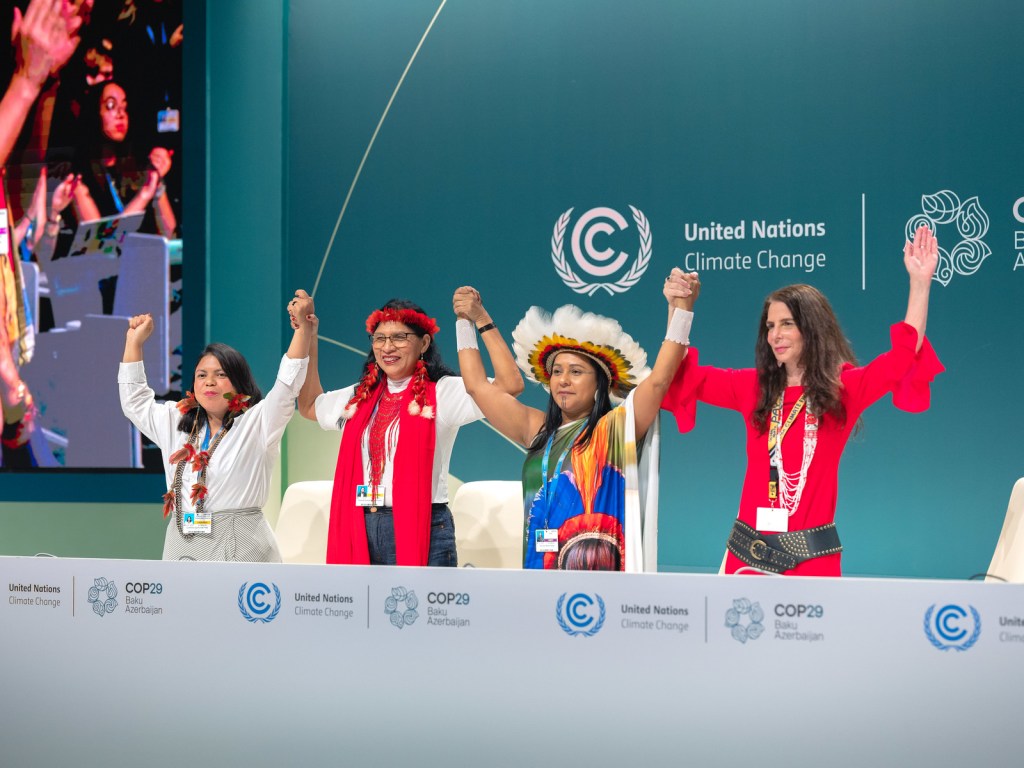
Featured Image: Mulheres indígenas do Brasil pedem ação urgente / Indigenous Women from Brazil Call for Urgent Action on the Road to COP 30. Read more: Indigenous Women Demand a Voice at COP30 (Photo credit: Ministério do Meio Ambiente e Mudança do Clima, November 2024, COP29. CC BY-NC-SA 2.0)
 FossilFreeUMC
3 responses to “Competing Worldviews at COP 30”
Sharon, nicely done. Thanks. Since the U.S. is boycotting this COP, it
is good to have interested citizen groups there promoting abolition of
fossil fuels extraction, use and financing. I am glad some from the UMC
are there even if they cannot fairly represent it, since it officially
remains despite efforts to change it a solid financial supporter of
fossil fuels and shows little sign of desisting. It is important to show
the world there are avid inside protestors seeking to end the UMC’s
knowing climate violence against people and planet. By the way, the city
of the event, being in a Portuguese language country, is spelled
“Belem”, with an m instead of an n, the Spanish spelling. We lived there
twice, 20 years apart. Included work on climate change.
Keep up the good work!
Bill
LikeLike
Excellent article. Where are you distributing it?
Lois
https://www.avast.com/sig-email?utm_medium=email&utm_source=link&utm_campaign=sig-email&utm_content=webmail Virus-free.www.avast.com https://www.avast.com/sig-email?utm_medium=email&utm_source=link&utm_campaign=sig-email&utm_content=webmail <#DAB4FAD8-2DD7-40BB-A1B8-4E2AA1F9FDF2>
LikeLike
UM Insight.
LikeLike