Thoughts on Climate Finance After the Conclusion of COP30
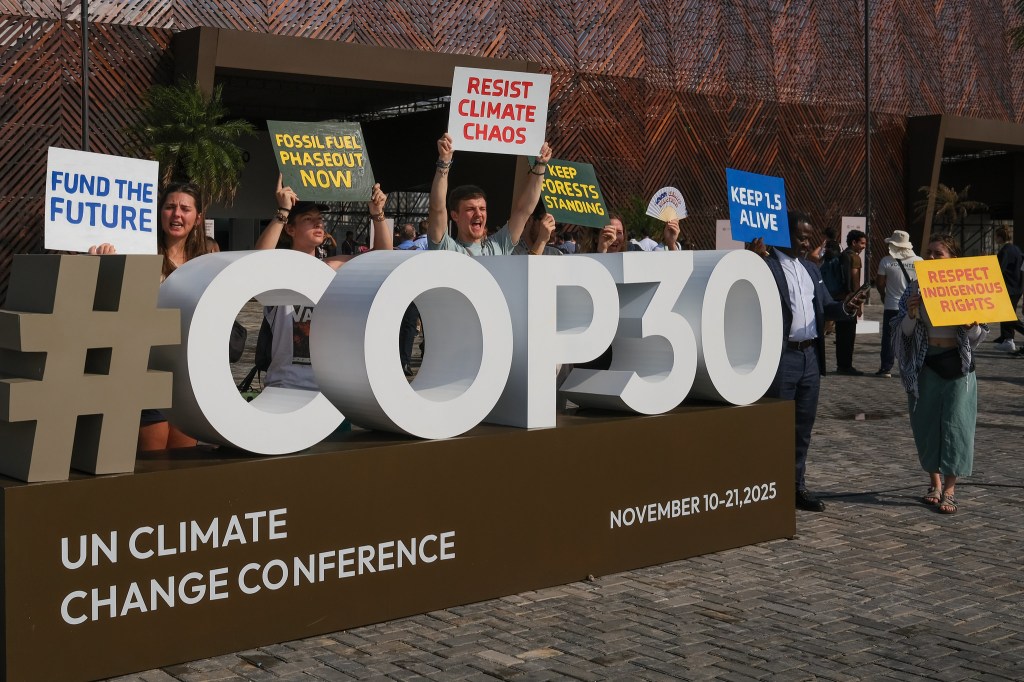
Around the venue, (Photo: © UN Climate Change – Diego Herculano)
Used under License CC BY-NC-SA 4.0.
By Rev. Joan Pell. Also published by United Methodist Insight and Texas Impact. You can read more about COP30 on the California-Nevada conference COP30 web pages
Have you ever made the right decision for the wrong reasons? Hold that thought for a moment as we ponder the outcome of COP30, particularly related to finance.
As I said in my previous COP30 posts (Will COP30 Deliver on Climate Finance? and Connecting the Dots), underlying the COP30 talks is the issue of finance. Who is going to pay for all the things we need to do to keep to the Paris Agreement? How much money will the developed nations give to developing nations to help them adapt to climate change? In the end, the goal of tripling adaptation finance by 2035 was passed, although it was weakened from the originally proposed 2030 target and it does not mention a specific baseline. New commitments called for accelerating reforms in multilateral development banks, enhancing the role of concessional and grant-based finance, and scaling innovative instruments such as guarantees, and blended finance. The urgent need to remain on the previously agreed pathway towards the goal of mobilizing at least USD 300 billion for developing country Parties per year by 2035 for climate action was “emphasized.”
Decisions taken at COP30 had to be agreed to by 194 countries. It was reported that 1,600 lobbyists linked to the oil, gas and coal industries were accredited to COP30, out of about 56,000 delegates. There is a lot of give and take and perhaps it is a miracle that any progress is made each year. Fossil fuels are the largest source of greenhouse gas emissions. I was surprised that the phaseout of fossil fuels was not on the official agenda for this COP, but uplifted when a group of more than 80 countries called for a roadmap to phase down oil, coal and gas to be kickstarted at COP30. Sadly, this did not materialize, and COP30 closed with no mention of fossil fuels. There was a promise from Brazil to work to create a roadmap process that will sit outside the UN climate regime; Columbia and the Netherlands also announced that they will organize the First International Conference on the Just Transition Away from Fossil Fuels. Drilled Media said in an article they published, “Multilateral diplomacy, however, is famously a place where hope goes to die … [but] If COP were a pointless exercise, it wouldn’t be targeted so heavily by the fossil fuel industry.”
During a side event, Andres Sutt, Minister of Energy and Environment of Estonia, shared the story of Estonia’s motivation and transition away from fossil fuels. In the winter in Estonia, resources are scarce; it is dark and cold, with not much sun and they cannot be wasteful, nor rely on others to turn on the lights. Twenty-first century thinking is that the green transition is the single biggest driver to prosperity, social security and justice. The developing countries can let the big players go first and take the tailwind, jogging at the back, and never win, or like Estonia, take the decision to treat it as an investment strategy. He urged countries to invest now and secure their place in the global value chain, but making sure the transition is fair, giving people real options and not just slogans, with retraining to upskill and a credible path to jobs. Since 1990, Estonia has seen its economy expand by 70% with a 62% reduction in CO2 emissions. He finished by saying that “net zero is not a cliff to fall off but a ladder to climb up.”
Governments are not the only sources of finance. Banks and insurance companies have a role to play in climate and diversity finance. Both hold large amounts of our money that they then invest to yield them good returns. At a side event about the response of the financial sector, Marika Reuter, Head of Sustainability Strategy Development for AXA, talked about how managing risk means reducing and preventing loss in any way possible, including unlocking capital to support clients trying to do large scale initiatives. For example, the oceans are a valued part of the world’s economy, and the Bahamas was offered a debt for conversion project where their debt was reduced in exchange for marine conservation where 3600 km of coastland, 700 islands and 80,000 flamingos were preserved, protecting not just nature, but livelihoods too, thus also saving them on insurance claims. There is a financial role for private investors to play too through their institutional investments, venture capital and philanthropic support. I have run out of space to describe what I heard about some of the wonderful work being done around the world.
Progress has been made in the ten years since the Paris agreement; without it we would be in an even worse situation, but it is not enough. There was some progress made at COP30, but it is still not fast enough. Holding onto hope is hard. I am thankful that the rate of rollout of renewable energy now seems to be on an unstoppable trajectory. Are countries, banks, insurance companies and individuals moving away from fossil fuels because it is the just and right thing to do or because it makes economic sense? As I connect the dots, the feint picture that I see emerging is one where the love of money is the force behind much of the climate progress that we are seeing; but perhaps that is okay if we are moving towards doing no harm. I still yearn for the day when justice for people and nature is the driving force and doing good is the goal.
Last week, as we sat in the northern hemisphere in the darkness of winter, Kate Bowler said in her advent reflections on hope that “Advent hope is grittier [than optimism or nostalgia]. It looks squarely at the world as it is—fragile, unjust, unfinished—and still insists that God is not done yet.” Paul says in Romans 8:24, “Now hope that is seen is not hope, for who hopes for what one already sees?” Or, as Bowler paraphrased it, “Real hope is forged in the gap between what is and what will be.”
Rev. Joan Pell is a retired clergy member of the California-Nevada Conference of the United Methodist Church. She serves, in a volunteer capacity, as their Conference Caretaker of God’s Creation Coordinator and as the Chair of the Conference Climate Justice Ministries Task Force. She also maintains the task force climate-cnumc.org website. In retirement, Joan enjoys having more time to travel, visiting her grandchildren, and pursuing advocacy and justice issues. She dreams of a just world with a safe and sustainable future where all of all of God’s creation is valued.
#fossilfreeumc, #COP 30, #climatechange, #climatefinance, #climatejustice, #climateaction
 FossilFreeUMC
One response to “Making the Right Decisions for the Wrong Reasons”
Hi Joan,
Very good and interesting blog. Thanks. Regarding the role of money vs.
virtue, I happen to have had some occasional contact around that, which
includes long term UN and related government and non-profit efforts to
move national policy development goals from ever increasing wealth to
high quality of life. It is turning out that doing the latter, which
demands moving toward sustainability, actually stimulates economies. So
much so that some are now selling that strategy publicly at least in
part as a means to economic development. But I would not be quick to
call that a “wrong reason”. It basically means that social justice can
have more tangible positive (including monetary) results than just
feeling good, something many activists at different levels–Liberation
Theology activism and the Cooperatives Movement for instance–have been
testifying to for a very long time. That has all along been an argument
for democracy, for instance. In my observation, such conciliation of
virtue and well-being (including economic) comes from relating to and
working directly with the people involved rather than just thinking
about them from afar. Might be a hint to the UMC to move away from
pontificating and get more involved in actual love relationships with
real people and places.
Keep up the good work!
Bill
LikeLike