Image used with permission by the Climate Reality Project
“We affirm our sacred calling to be responsible stewards and to lovingly tend all that God has wrought. We recognize the inherent worth of God’s creation, celebrate earth’s abundance and diversity, and, along with the entirety of the cosmos, give praise to its Creator. We recognize we are interconnected members of complex ecosystems, intricate webs of life, all of which have their origins in God’s gracious act of creation….the traditional wisdom found within Indigenous communities, particularly the emphasis that native and first peoples have placed on living in harmony and balance with the earth and other animals as well as the need to protect the air, land and water.” — United Methodist Social Principles, The Community of All Creation
The previous post, The Fierce Urgency of Now in Response to Climate Change,” described the need for urgent action in response to rapidly accelerating fossil fuel emissions and rising global temperatures, which pose a grave and urgent threat to the human family and to creation. This post identifies four obstacles to strong climate action. Solar, battery, and wind technologies are advancing dramatically and in many cases are cheaper than fossil fuels. What is holding us back?
The first three answers come from Al Gore’s most recent Climate Reality Project slide deck, which I have access to as a trained Climate Reality Presenter. These are: 1) fossil fuel investments, 2) fossil fuel subsidies, and 3) fossil fuel companies. The fourth obstacle is one that I have written about extensively: 4) the problem of conflicting worldviews that lead to stalemates on climate action.
1. Fossil fuel investments or, in the words of the Climate Reality slides, “the global financial system for allocating investments.” There is growing energy demand and investment in both fossil fuels and renewables, but financing is uneven. In 2024, emerging markets and developing economies received only 15% of global clean energy spending.
An example is Africa, a prime location for solar power, which receives only two percent of the world’s clean energy investments but is being flooded with fossil fuel investments. Since the Paris Climate Agreement was signed, financial institutions have sunk hundreds of billions of dollars into fossil fuel corporations that fund oil, gas and coal projects in Africa. These institutional investors include pension funds, mutual funds, asset managers, insurance companies, hedge funds, commercial banks, sovereign wealth funds and other investors.
Transitioning to a clean energy future must be equitable and inclusive. Clean energy investment must be available to developing nations not only as a moral imperative so millions won’t be left behind, but also to meet global climate goals. A note here: Our Board of Pensions, Wespath, has over $1 billion invested in fossil fuel companies. It may be a drop in the bucket of global investment firms, but it’s not nothing.
2. Fossil fuels subsidies by national governments, according to the IMF, amount to a stunning $7 trillion annually. This amounts to $13 million per minute of taxpayer dollars subsidizing fossil fuels each year through direct subsidies, tax breaks, and unpriced externalities. The United States alone funds direct and indirect fossil fuel subsidies by $760 billion per year. These exorbitant subsidies distort energy prices, hinder a just transition away from fossil fuels, and keep the fossil-fueled economy going and growing.
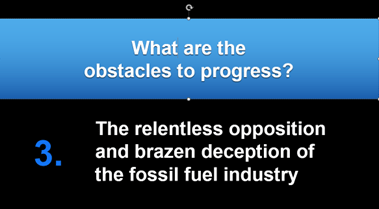
3. Fossil fuel companies, or as stated on the Climate Reality slide, “The relentless opposition and brazen deception of the fossil fuel industry.” Big oil, gas, and coal corporations spend vast sums deliberately blocking climate action. They use their immense wealth and power to sway public opinion through the media, elect candidates of their choice, and lobby to block climate-friendly legislation. This dynamic ensures that many elected officials see their interests as tied to corporate interests and so are unwilling to stand up against their demands. Their conflict of interest is clear, and their undue influence prevents strong climate action at every level of government, including at climate conferences.
Further, while the fossil fuel industry has known for decades that their products would heat the planet and cause disaster, they doubled down on production and hid the truth through a massive campaign to manufacture doubt about the reality of climate change. They now use additional tactics to confuse and paralyze the public and expand their production of fossil fuels.
Climate lawsuits have recently been filed against the world’s largest oil, gas, and coal corporations, including BP, Chevron, ExxonMobil, Shell, and others. Their misinformation campaigns and lobbying efforts to undermine climate policy are a big cause of the logjam on effective climate action. We have the technology we need for a just transition to a clean energy future, but fossil fuel corporations have something else, something more profitable for them, in mind. It is time to call out fossil fuel corporations as bad corporate actors and to reject them as investment partners.
I see another obstacle, which is overarching, and which incorporates fossil fuel investments, fossil fuel subsidies, and fossil fuel companies:
4. Conflicting worldviews/conflicting paradigms, which I have written about extensively, including in this article: Competing Worldviews at COP 30. There are two opposing worldviews at work in conversations about how to stabilize the climate and achieve climate justice.
The quote from the United Methodist Social Principles above upholds the inherent value of God’s creation and emphasizes Indigenous wisdom, but this perspective is at odds with the “conventional wisdom” of the dominant worldview. The values, worldview, and model for society that characterize our global system of corporate-dominated, unrestrained free market capitalism differ from those of the movement for climate justice. The paradigm of the present world order has been described as top down, violent, hierarchical, market based, and anthropocentric. It exemplifies the patriarchal values and structures that have undergirded colonization and empire. The emerging paradigm is community-based, egalitarian, nonviolent, people-friendly, and earth-centered.
In today’s global order, market-based approaches to climate action take priority. The global economy continues to revolve around fossil fuels, which as we have seen are highly subsidized even as solar, wind, and other renewable technologies become more affordable. This dynamic is an obstacle to strong climate policies, leading to calls by climate justice activists for “system change not climate change.” These competing worldviews obstruct decisive climate action to phase out fossil fuels and support equitable climate financing, as called for by marginalized groups that represent climate-impacted nations and are often led by Indigenous people.
The church is uniquely situated, in its preaching and teaching, to challenge the dominant narrative, which sees the gifts of the earth as for-profit commodities to be incorporated into the global marketplace. Instead, our Social Principles encourage us to affirm a worldview aligned with the values of the reign of God and informed by Indigenous peoples who have lived sustainably on the earth for millennia, and who honor all the interrelated parts of creation as essential. This may be the church’s most important contribution to this struggle.
The previous post was The Fierce Urgency of Now in Response to Climate Change. The third and final post in this series will address “A Merciful, Just, and Proportional Response to Climate Change,” which will be published soon.
The Reverend Sharon Delgado is the Convener of Fossil Free UMC, which advocates for the United Methodist Church to divest from fossil fuels, and is on the Coordinating Committee of the United Methodist Creation Justice Movement. The revised edition of her book Love in a Time of Climate Change was released in January 2026 and is available now. Sharon’s other writings and information about her books and presentations can be found at sharondelgado.org.
#fossilfuels, #climatefinance, #fossilfuelsubidies, #fossilfuelinvestments, #competingworldviews, #competingparadigms, #marketbasedsolutions, #unitedmethodistsocialprinciples, #communityofallcreation, #unitedmethodistchurch, #obstaclestoclimateaction, #systemchangenotclimatechange, #climatejustice, #climatechange
 FossilFreeUMC