Comprehend the scientific facts regarding the current harms and projected dangers facing humans and planetary systems at the 1.5-degree threshold of global temperature rise.
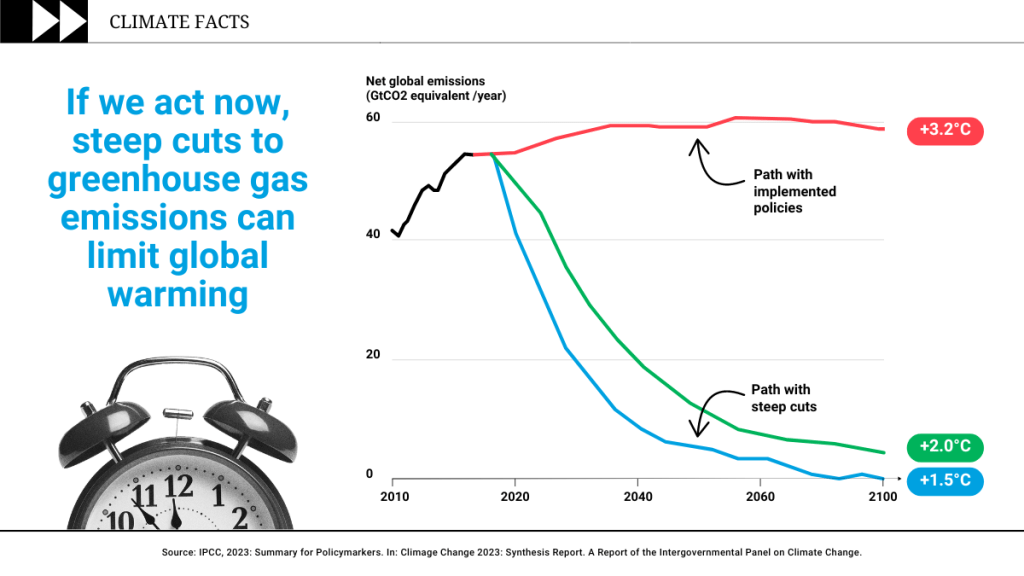
Since 2023 average global temperatures have spiked, alarming scientists. Global temperatures are now hovering around 1.5°C, the lower limit of the Paris Agreement. The whole point of the goal of “net zero by 2050” was to limit overall warming to no more than 1.5°C or well below 2°C above preindustrial levels, and we are on the brink of shooting past those limits. Section B-6 of the most recent report of the IPCC describes the urgent climate action that is required: “All global modelled pathways that limit warming to 1.5°C . . . and those that limit warming to 2°C . . . involve rapid and deep and, in most cases, immediate greenhouse gas emissions reductions in all sectors this decade.” The report also highlights the scientific basis that proves the urgency of phasing out fossil fuels, the primary driver of climate change. This need to phase out fossil fuels is the basis for the growing global movement to divest from fossil fuels.
Deep cuts in fossil fuel use and resulting emissions are needed in this decade, starting now. Yet according to a recent report, the world’s 100 largest fossil fuel companies are increasing production, which would now lead to emissions three times higher than the Paris climate agreement targets. Big commercial banks and investment firms, including pension funds, are financing much of this expansion. If the world doesn’t phase out fossil fuels, renewable power may end up supplementing rather than replacing them because of the expected tripling of the production of petrochemicals for global plastics by 2050 and the massive energy demand for fossil-fuel-based power plants to run AI and cryptocurrency data centers.
The consequences of rising fossil fuel emissions and rising global temperatures include more extreme weather conditions leading to increased deaths and loss of property, more rapid species extinction, widening drought conditions, decreased food production, increasing migration, expanding health risks of infectious and vector-born illnesses, which are already happening now. We must stay clear eyed about the reality of what is at stake and respond as faithfully as we can.
The scientific community, people engaged in the struggle for climate justice, and people of faith have raised the alarm! These next decades we share together are not “yet to come,” they are with us and unfolding now. Our current path is creating one billion refugees, making swaths of the globe uninhabitable, emboldening violent and repressive regimes, and causing mass global extinction. Urgent action is needed now to phase out fossil fuels to prevent escalating warming.

