These talking points offer reasons why it is so important to support the petition to General Conference calling for “fossil fuels” to be added to list of ethical investment screens in The United Methodist Book of Discipline.
Primary Talking Points on why the UMC should divest from fossil fuels
- To live by our faith commitments.
- To practice what we preach about climate change.
- To safeguard our investments and legacy.
- To align our environmental stewardship with our financial stewardship.
- To stop providing moral cover for bad actors.
- To move toward climate justice.
- To act for Intergenerational Justice.
- To move toward net zero carbon emissions.
- To send a clear message to political leaders and fossil fuel corporations.
- To transform the system that causes climate change
(See links to other talking points here.)
For a detailed explanation of each of these talking points, see below.

“Until the world moves away from fossil fuels and reduces emissions to net zero, extreme weather will continue to become more intense.”
WorldWeatherAttribution.org
1. To live by our faith commitments.
Jesus taught that the greatest commandment is to love God above all and our neighbor as ourselves. By investing in fossil fuels that destabilize the climate, we dishonor God by financing the destruction of God’s creation, and we contribute to the suffering of our neighbors near and far who are impacted by fossil fuel pollution and climate change, including children and future generations.
We dishonor God by financing the destruction of God’s creation.
Surely Jesus, who said “just as you did it to one of the least of these siblings of mine, you did it to me” (Matthew 25:40), calls us to consider our impacts on those who are most vulnerable in all our decisions, including our investments.
Our Wesleyan heritage acknowledges the call to both personal and social holiness. Social holiness today must include considering the impacts of our lifestyles, actions, and investments in the context of a warming world.
“Better no trade than trade procured by villainy…. Better is honest poverty than all the riches bought by the tears, and sweat, and blood of our fellow creatures.”
John Wesley, Thoughts Upon Slavery
John Wesley condemned the slave trade for its pursuit of profit at the expense of justice. In the context of climate change, we should condemn the pursuit of profit at the expense of justice in financing fossil fuels and be willing to relinquish investments that cause grave harm.
2. To practice what we preach about climate change.
Divesting from fossil fuels will align our investments with The United Methodist Church’s statements and resolutions calling for climate action since 1980. Many United Methodist churches, boards, and agencies currently hold investments in fossil fuels, the primary driver of climate change. This includes Wespath, one of the largest faith-based pension funds in the world. Wespath serves more than 100,000 active and retired clergy and lay employees of the Church.
As a denomination, United Methodists and UM Ministries still fund and profit from the “money pipeline” that finances the coal, oil, and methane gas extraction, transport, refining, exporting, and infrastructure that damages creation and endanger the future.
“The exceptional warming that we’re experiencing is not something we’ve seen before in human history. It’s driven primarily by our fossil fuel emissions…”
Gavin Schmidt Director of GISS, NASA Analysis Confirms 2023 as Warmest Year on Record [again, after 2022, 2021…]
Investing in fossil fuels puts us at cross purposes with the just and sustainable transition that we claim to be working towards. The year 2023 was the hottest year ever recorded, and 2024 is on track to surpass that record. By investing in fossil fuels, The United Methodist Church is profiting from practices that we know will lead to billions of deaths over time.
It is time to practice what we preach as United Methodists, stop financing the fossil fuel industry, and invest instead in projects and technologies that will lead us to the just and sustainable clean energy future that we proclaim. For more on this topic, read Walking Our Talk About Climate Change.

3. To safeguard our investments and legacy.
Investing in fossil fuels is a losing strategy in the long run. Fossil fuel investments become riskier as the climate warms, as lawsuits against fossil fuel companies become common, as costs rise for climate-related damages at home and abroad, as governments enact strong climate policies, and as renewable sources of power become cheaper.
“Stranded assets” are assets that, while they may show up on paper, are essentially worthless to investors. Reserves of coal, oil, or methane gas upon which fossil fuel companies are valued become “stranded assets,” and have no real value, if they cannot be burned. Some financial analysts claim this situation is a “carbon bubble,” which will burst once governments get serious about ending fossil fuel subsidies, phasing out fossil fuels, and moving to a clean energy future.
“Fossil fuel companies face the same liability litigation as tobacco companies did. They will lose just like tobacco did. They are the reason that developing countries facing the climate crisis are seeking `loss and damage’ compensation.”
Mike Koob, Baltimore-Washington Conference
If we continue investing in oil, coal, and gas, we contribute to propping up the current fossil-fuel based global system, which is time-bound anyway. Climate disasters already upon us make clear that if the current rate of warming continues, human, ecological, and financial costs of destruction will escalate indefinitely, wreaking unimaginable havoc.
Studies examining the financial impact of excluding fossil fuels from investment portfolios show that for past performance, the impact is negligible. In calculating future risk, research shows that screening fossil fuels may reduce overall portfolio risk. By doing so, we safeguard both our investments and our legacy.
4. To align our environmental stewardship with our financial stewardship.
The United Methodist Church has a long history of screening industries from its investments when their core business activities conflict with The Social Principles. We have already taken clear ethical positions against investing in alcohol, tobacco, gambling, pornography, weapons, and private prisons, as listed in the Book of Discipline, Paragraph 717, “Sustainable and Socially Responsible Investments.”
“Screening fossil fuel investments means walking away from the companies that are most resistant to addressing the climate challenge and toward those that are working on solutions.”
Rev. Mark Davies, Oklahoma Annual Conference
So far, we have not established any screens based on environmental sustainability, yet the suffering and harm caused by climate change will meet or surpass the harm caused by any of the industries from which we have already divested. The burning of fossil fuels accelerates global climate change, which now threatens the stability of civilization and the balance of life on earth.
Adding “fossil fuels” to our list of ethical investment screens would be a step in taking environmental stewardship as seriously as we take financial stewardship, and in aligning the two. To see the exact wording the General Conference Petition to screen out fossil fuels from our investments, read Our First Task. For more on this topic, read Why Invest in Fossil Free UMC?
5. To stop providing moral cover for bad actors.
The United Methodist Church’s decades-long strategy of corporate engagement with fossil fuel companies as shareholders has failed to produce results that protect the climate. There has been no movement toward relinquishing the source of their profits and power.
“As a shareholder in fossil fuel companies, the United Methodist Church holds a share in their profits, and thus we hold a share of the responsibility for the ecological damage and loss of a livable climate that these companies perpetuate. When we as a denomination profit from investing in fossil fuel interests, we weaken our prophetic resistance and become complicit in profiting off the demise of the community of all creation.”
Rev. Mark Davies, Oklahoma Conference. Read Turn Over the Tables and Why Working with Fossil Fuel Companies Won’t Work
While researchers at IEA and global leaders at the UN concur that there must be no new oil and gas infrastructure, and that an immediate reduction is necessary to avert “catastrophe,” oil and gas companies continue to build pipelines and develop oil fields. This behavior risks planetary ecocide: Gas-fired power sector booming like there’s no tomorrow. The 134GW of gas-fired power capacity under construction worldwide is similar in size to that constructed globally over the past five years.
To return to John Wesley: this is the blood, sweat and tears of all living things. This is villainy.
Global oil, gas, and coal corporations continue to blatantly harm God’s good creation. They are bad actors who have lied about the danger of their products, promoted denial about climate change, lobbied against climate legislation, and delayed the transition to clean renewable energy. Their core business model depends upon the expanded production and use of their primary product: fossil fuels.
6. To move toward climate justice.
As fossil fuels pollute the atmosphere and as global temperatures rise, every place on earth is affected. But people in marginalized neighborhoods, regions, or countries increasingly suffer the most severe effects. Pollution from fossil fuel extraction, transport, and refining projects cause harmful health impacts, primarily in black, brown, and Indigenous communities.
Read Frontline Communities, Climate Justice, and Divestment to find out more about the impacts of climate change and fossil-fuel projects on frontline communities, how they are fighting back, and how we can be allies in the struggle for climate justice.
Rising temperatures and climate-related disasters trigger hunger, homelessness, regional conflict, and mass migration, counteracting efforts to reduce poverty and suffering in the very regions where faith-based groups reach out in mission to provide relief. In the US, hurricanes grow in strength, proposing now a new ‘Category 6‘ strength assessment. Repeated floods in the American Midwest kill crops, livelihoods and neighborhoods. In Europe drought and heat killed 70,000 people in 2022 alone.
The African continent is especially hard hit by drought and water shortages, endangering basic food crops and threatening famine. As glaciers melt and sea levels rise, low-lying regions like the Philippines, Bangladesh, and island nations experience disastrous flooding from monsoons, hurricanes, and other serious storms. We know this, yet The United Methodist Church continues to fund the fossil fuels that drive climate change. See 10 Talking Points for Central Conferences.
Significantly, most of the poorest and most climate-vulnerable nations have contributed least to the climate crisis. They are calling for strong action for climate justice, including funding for “loss and damage” and a “phaseout” of fossil fuels. As United Methodists, institutional divestment is a practical way to respond to these calls, begin to phase out fossil fuels from our own portfolios, and participate as allies with the global movement for climate justice movement, which is growing in strength.
For a perspective on this topic from a young Ugandan climate activist and UNICEF goodwill ambassador, read Rich countries should stop pushing fossil fuels on Africa—don’t we deserve a renewable future too? by Vanessa Nakate.

7. To act for intergenerational justice.
Intergenerational justice is fair and just treatment for the world’s children, youth, and future generations. Epidemiologists report that most climate change victims are children. For example, in Somalia in 2022, children under age five accounted for half of the 43,000 total deaths attributed to climate impacts. Climate destabilization also leads to disproportionate harms to girls, including rising rates of child marriage.
Much of this harm to children takes place in poor countries that have contributed little to climate change. A World Council of Churches initiative, “Climate-Responsible Finance: A Moral Imperative towards Children,” links climate impacts on the world’s children with a call to action by churches related to the financing of fossil fuels.
“…there is an urgent need for recognition that climate destruction is a trigger of violence against children and against future generations…. As people of faith, we are called to tackle the root causes of the climate emergency, as an urgent measure for protecting children from the dire consequences of a warming world.”
Frederique Seidel, World Council of Churches Senior Advisor on Child Rights
United Methodist fossil fuel investments contribute to these dire consequences for children. Divesting from fossil fuels is a way to tackle the root causes of the climate emergency by rejecting fossil fuel profits and investing in a more merciful, regenerative, life-giving world now and into the future.
For more on this topic, read the new report co-authored by the World Council of Churches, WCC: Climate Change Poses a Growing Threat to Children’s Health and Well-Being.
8. To move toward net zero carbon emissions.
Annual Conferences and United Methodist Boards and Agencies are seeking to achieve net-zero emissions, some by 2040, others by 2050. Investing in fossil fuel companies actively building pipelines and digging wells functions as a financial bet against that effort.
Of the thirteen United Methodist agencies and the Council of Bishops committed to achieving “Net Zero” by 2050, here is excerpts from their statement of commitment:
“Transitioning to a net-zero world will require transforming how we produce, consume, and move about. Replacing polluting coal, gas and oil-fired power with energy from renewable sources, such as wind or solar, would dramatically reduce carbon emissions.” Divesting from fossil fuels is a concrete way for our denomination to move toward “replacing polluting coal, gas and oil-fired power with energy from renewable sources.” Agencies Commit to Net Zero Goals.
The Pacific Northwest Conference, West Ohio Conference, and Northern Illinois Conference are among those who passed resolutions to achieve Netzero. They join many other conference teams active with creation care teams and task forces. Read also about Northern Illinois Conference’s commitment to netzero: Net Zero team seeks to Do No Harm to God’s good creation.
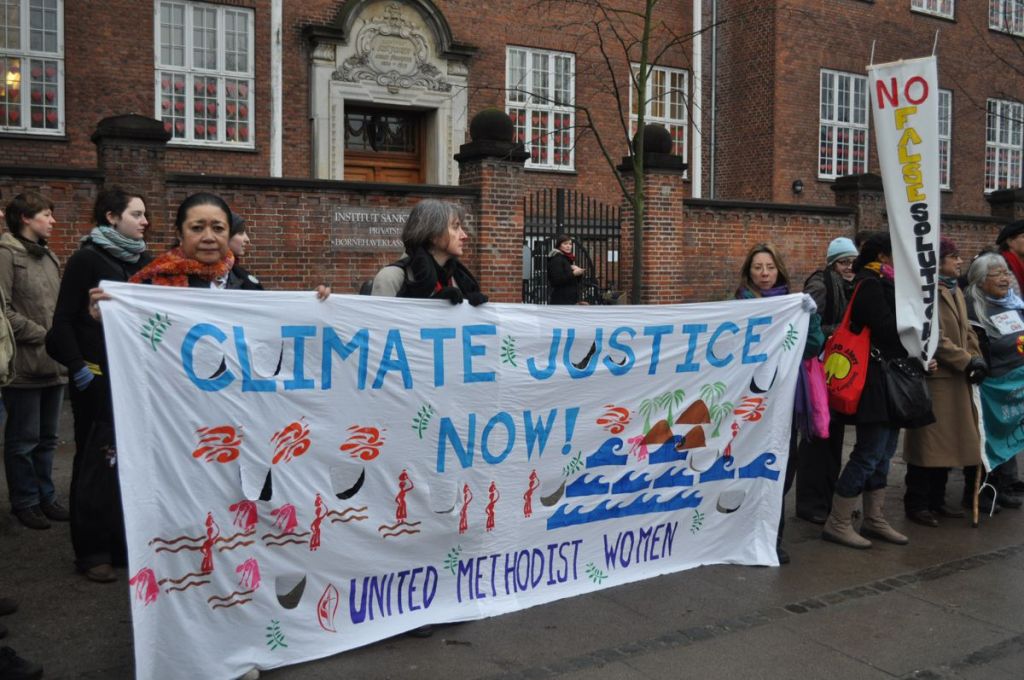
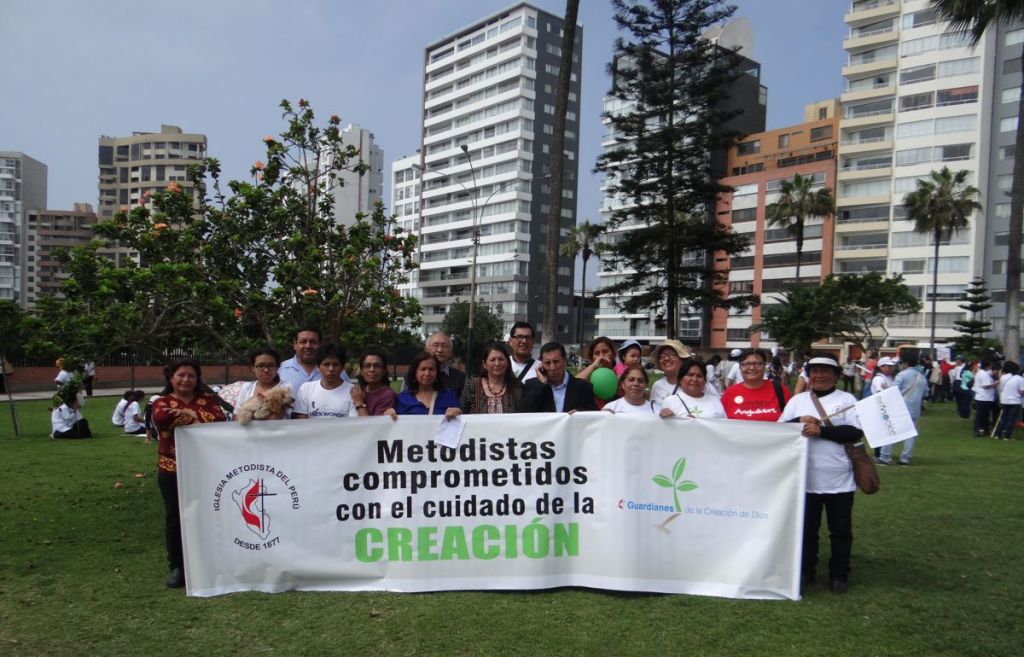
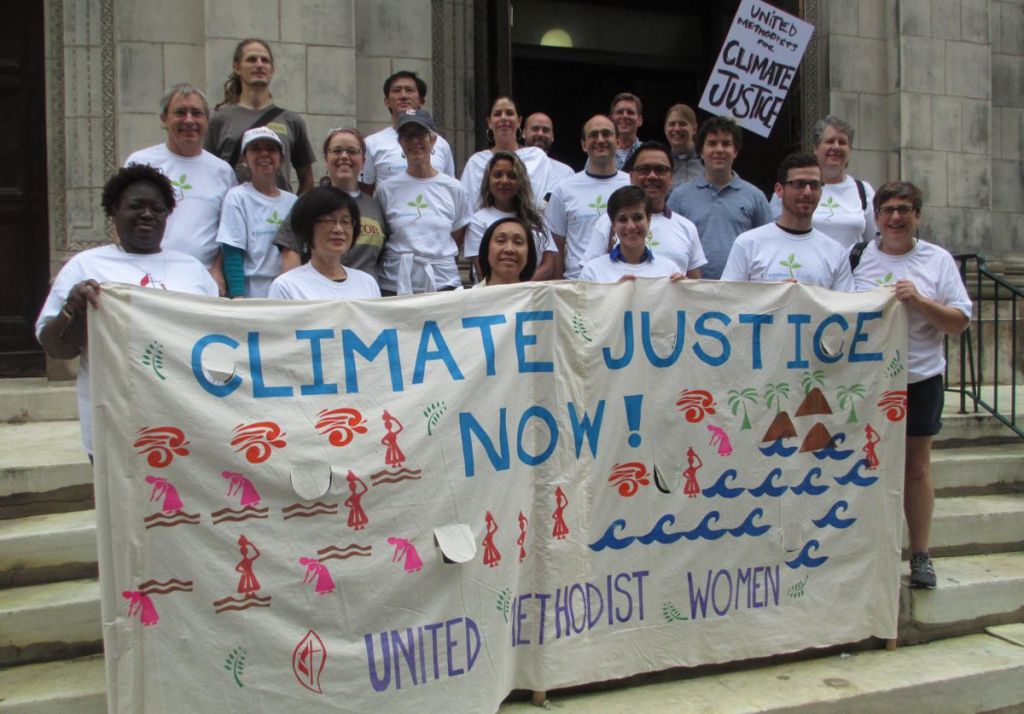
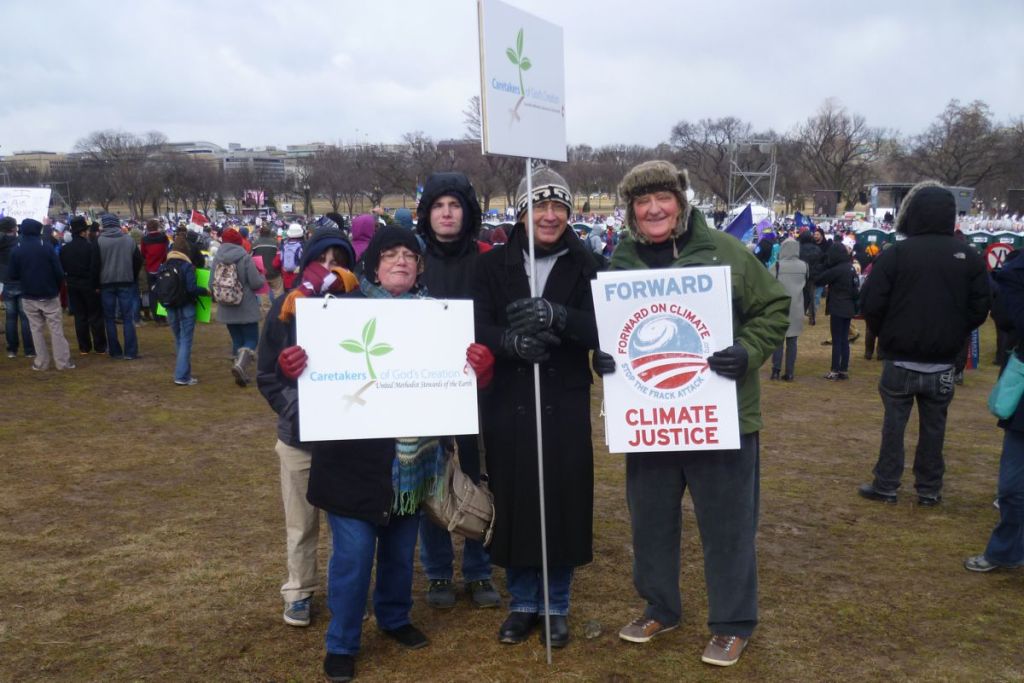
Repeatedly and ongoingly, United Methodists have demanded action for creation. Photos by Rev. Pat Watkins.
9. To send a clear message to political leaders and fossil fuel corporations.
Political leaders in the US and worldwide have not been able to stop or reverse the escalating greenhouse gas emissions that cause climate change. Fossil fuel corporations use their wealth to lobby politicians to prevent strong climate action and continue to build durable new infrastructure that locks us into the use of oil, gas, and coal for decades. This is untenable.
Instead, by divesting from fossil fuel corporations, and eschewing false solutions, such as biofuels, we cut off the social license and veneer of respectability that The United Methodist Church bestows on oil and gas. Our presence at the corporate table implies oil-filled portfolios are worthy of investment. We join other faith groups who agree that engagement has failed. We must take action ourselves to phase out our investment in fossil fuels and to invest instead in goods and services that support a clean energy future.
We “vote with our feet,” our hands, our hearts, our Spirit, and our faith by taking action for this good earth and the generations to come.
Divestment sends a clear message to both fossil fuel companies and political leaders that we are done waiting. The time has come to set an example by phasing out fossil fuels from our own portfolios. Adding changes to screen out fossil fuel investment in Paragraph 717 is the United Methodist Book of Discipline will make this change.
10. To transform the system that causes climate change.
If Fossil Free UMC’s petition to add fossil fuels to our list of ethical investment screens passes at General Conference, it would contribute to systemic change by removing the moral endorsement of fossil fuels that we provide through our current investment practices. We see the dominant system everywhere: news of domination and violence, human social organization forced to conform to the Market, extraction and destruction of ecosystems, and racial, ethnic, gender, class, and other hierarchies based on who is at the top of today’s corporate-domination global system.
“Money spent on building gas supply infrastructure is money that can’t be used for investment in the industry of the future: clean, secure, renewable energies such as solar and wind.” Source.
Vanessa Nakate
Yet faith enables us to also glimpse a new moment in the promise of Abraham, an alternative to the dominant system and its values, based instead on the compassion, justice, inclusivity, and nonviolence that characterized Jesus’s life and on care and concern for all creation. This is relevant for our understanding of today’s ongoing struggle to address climate change in meaningful ways.
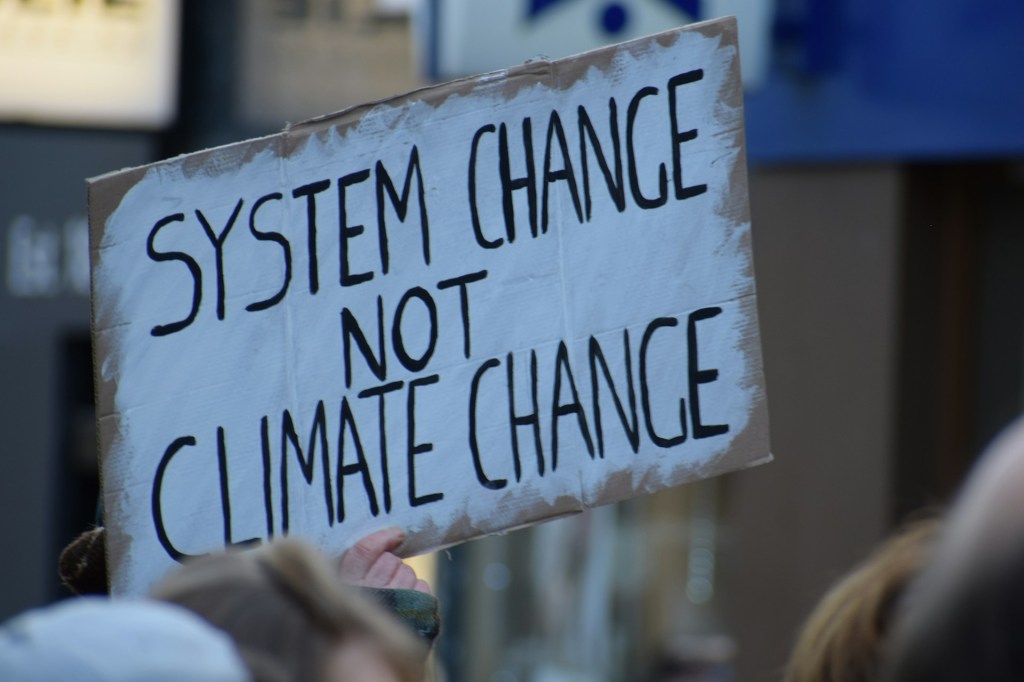
The movement for climate justice is growing stronger, led by those most impacted by climate change. Its goal is “system change not climate change.” For more on this topic, read A Fossil Free UMC Response to COP 28: The Limitations of the Dominant Paradigm for Climate Rescue by Sharon Delgado.
Contact us at info@fossilfreeumc.net.
Developed by Fossil Free UMC in preparation for General Conference. Please also see our general talking points, Ten Reasons Why The United Methodist Church Should Divest from Fossil Fuels. For more of Fossil Free UMC’s talking points, go to, Ten Reasons for Central Conferences to Support Fossil Fuel Divestment, Ten Reasons for Wespath to Support Fossil Fuel Divestment, and Plain Talk: This is what’s at Stake.
Photo credit, storm photo with woman, Shashank Sahay.
Thank you to Rev. Paul Jeffrey / Life on Earth Pictures for the photo of South Sudan and the Philippines shown here. Find him at Global Lens. Find more of Paul Jeffrey’s photos also in the post 10 Reasons for Central Conferences to Support Divestment.


6 responses to “Ten Reasons Why The United Methodist Church Should Divest from Fossil Fuels”
Nicely done!
LikeLike
With global warming out of control there’s no question but that we United Methodists at all levels should divest from fossil fuels!
LikeLike
[…] For more on Intergenerational Justice and children, see #7 of our general talking points, Ten Reasons Why The United Methodist Church Should Divest from Fossil Fuels. […]
LikeLike
Over 1600 churches, Foundations schools, and institutions have divested from fossil fuels since the campaign started 10 years ago. It is time for The United Methodist Church to join the divestment movement.
LikeLike
[…] Developed by Fossil Free UMC in preparation for General Conference. Please also see our general talking points, Ten Reasons Why The United Methodist Church Should Divest from Fossil Fuels. […]
LikeLike
[…] find 10 reasons for Wespath to divest. Look also at our 10 reasons for the United Methodist Church and Central Conferences to seek […]
LikeLike