by Sharon Delgado
Last week I met with an Annual Conference delegation to General Conference to explain why Fossil Free UMC promotes the General Conference petition to add fossil fuels to our investment screens. At the meeting, one of the delegates reminded me of how important it is as part of our campaign to make visible the multiple injustices resulting from climate change and our fossil fuel-based economy.
Climate change is an issue of justice. Since the early 1980s, The United Methodist Church has advocated for environmental justice, thus merging concerns for creation with a commitment to racial and economic equity. Efforts to combat environmental racism were initiated by Black churches and communities that were directly impacted by the disproportionate number of toxic waste dumps and polluting industries placed in their communities.
Today these disproportionate impacts have led to a focus on climate justice, which links alleviating climate change with justice for people disproportionately harmed by its impacts (in marginalized countries or communities), justice for people in communities polluted by the extraction and processing of fossil fuels (usually Indigenous people and people of color), and intergenerational justice (for children, young people, and future generations). A primary challenge for churches is to join with the climate justice movement as allies in solidarity with people on the front lines of these struggles and to oppose the powers that perpetuate the harm.
Divesting from fossil fuels and reinvesting in a just transition to a clean energy future means we refuse to fund these powers. To some this may seem radical, but as according to climate scientists and those most deeply impacted, we no longer have time for gradual change.
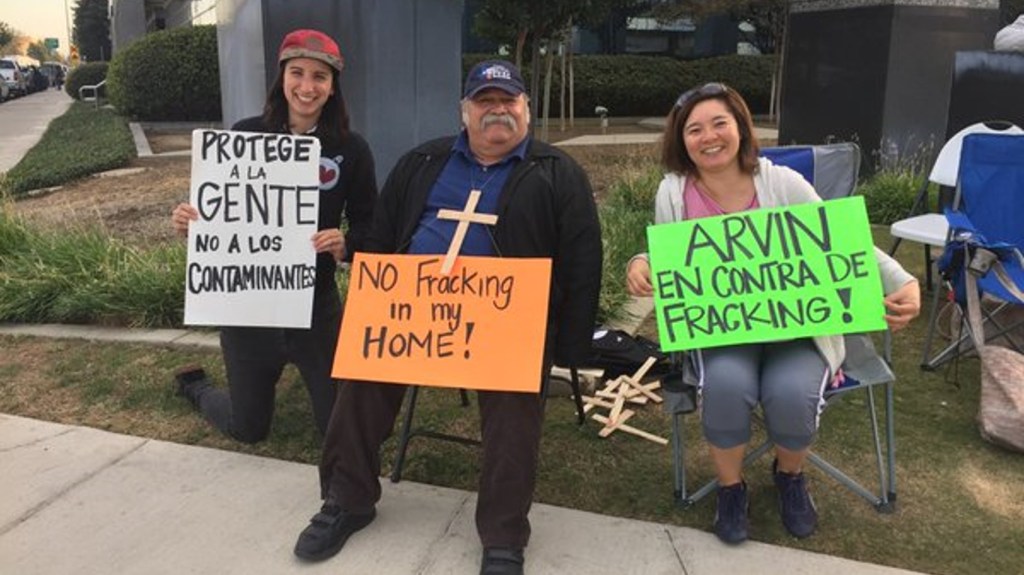
In terms of climate justice, frontline communities are those that experience the most immediate and worst impacts of climate change as well as those that are most vulnerable to pollution by fossil fuel extraction, transport, and processing. These are often low-income communities of color, often in neighborhoods or regions that are treated as “sacrifice zones” for the sake of the fossil fuel economy.
Kern County, California, which has a majority Latinx population,[i] has many frontline communities and some of the most polluted air in the United States. It accounts for 80% of California’s oil and gas production, with 78,000 oil and gas wells, mostly in low-income communities.[ii] Plans are being made for 43,000 new oil and gas wells to be installed over the next two decades.[iii] Air pollution from these wells disproportionately impacts Latinos, Black, and Indigenous people. Activists are organizing to stop the new wells and to create setbacks from schools and neighborhoods for existing wells.
In 2021, community groups in Southwest Memphis defeated an oil pipeline that would have threatened the drinking water and posed further risks to frontline, predominately Black, communities. Plains All American Pipeline had planned to route the Byhalia Pipeline through Southwest Memphis, including Boxtown, which was named after formerly enslaved people who built their homes out of used metal and wood scraps from train boxcars. Community members, already living with high air pollution due to toxic industries, were outraged when a pipeline representative described the pipeline route as a “point of least resistance,” thus showing a lack of respect for marginalized communities with little political power. The pipeline’s defeat was experienced as a victory for the people.[iv]
The Chevron Oil refinery in Richmond, California, is home to the East Bay’s largest polluter and is the state’s top emitter of greenhouse gas pollution. Refinery pollution contributes to high rates of asthma, cancer, and heart disease among Richmond residents, mostly people of color. On August 6th, 2012, an explosion sent 15,000 residents and 19 workers to the hospital. It was caused by the processing of heavier (dirty) crude oil and management failures in refinery safety and maintenance. Chevron continues to push for the expansion of its Richmond refinery, which would enable the processing of dirtier crude oil and lead to more pollution and more potential accidents.[v]
Community organizing in Richmond, led by Communities for a Better Environment, has gone on for decades, and the work continues. Progressives now hold a majority of seats on the town’s city council and have taken on Chevron and other polluting industries, banning the export of coal from Richmond’s port and suing fossil fuel companies for their role in climate change.[vi]
Similar campaigns are going on in frontline communities around the world. They are networking together across borders. With the help of groups like the The Climate Justice Alliance, an alliance of urban and rural frontline communities, organizations, and allies working for climate justice in regions throughout the United States and internationally.
The global campaign to divest from fossil fuels is one tool that is promoted by the movement for climate justice. To some this may seem radical, but according to climate scientists, as well as people on the front lines, we no longer have time for gradual change.
Andrés Soto, a CBE community organizer in Richmond said, “It is the frontline communities that are articulating in many ways the most radical solutions, because they are dealing with the most radical impacts.” He adds, “As the situation gets worse, people are going to want more radical action. And that is, I think, where the hope is.”[vii]
The Reverend Sharon Delgado is on the Coordinating Committee of the United Methodist Creation Justice Movement and is the Convener of Fossil Free UMC. She is author of The Cross in the Midst of Creation, Love in a Time of Climate Change, and Shaking the Gates of Hell.
[i] California Demographics by Cubit, https://www.california-demographics.com/kern-county-demographics
[ii] “New ordinance being considered could bring more oil wells to Kern, some express concern,” Bayne Froney, 23ABC, https://www.turnto23.com/news/local-news/new-ordinance-being-considered-could-bring-more-oil-wells-to-kern-some-express-
[iii] “Kern County OKs plan for thousands of new oil and gas wells over environmental objections,” Brian Melley, Los Angeles Times, March 9, 2021, https://www.latimes.com/environment/story/2021-03-09/kern-county-approves-new-oil-and-gas-wells-over-environmental-objections
[iv] “Victory for Southwest Memphis: Byhalia Pipeline is done,” Southern Environmental Law Center, July 2, 2021, https://www.southernenvironment.org/news/victory-for-southwest-memphis-byhalia-pipeline-is-done/
[v] CBE Advocates for a Just Transition from Fossil Fuels to Building a New Healthier and Thriving Economy, Communities for a Better Environment, https://www.cbecal.org/organizing/northern-california/richmond/#plan
[vi] CBE Advocates for a Just Transition from Fossil Fuels to Building a New Healthier and Thriving Economy, Communities for a Better Environment, https://www.cbecal.org/organizing/northern-california/richmond/#plan
[vii] “After Oil: Chevron’s refinery in Richmond, Calif., is a major polluter. Can the activists trying to shut it down convince its 3,000 workers they’re on the same side?” Madeline Ostrander, The Nation, Oct. 14, 2023, https://www.thenation.com/article/archive/refinery-richmond-climate-change/
 FossilFreeUMC
One response to “Frontline Communities, Climate Justice, and Divestment”
[…] projects cause harmful health impacts, primarily in black, brown, and Indigenous communities. Read Frontline Communities, Climate Justice, and Divestment to find out more about the impacts of climate change and fossil-fuel projects on frontline […]
LikeLike