Scroll down to jump to the Model Resolution for Divestment
What is a ‘Model Resolution?’ Resolutions or Legislation, also sometimes called a Petition, is a proposed rule for how the Methodist Church governs itself. Resolutions are submitted to Local Churches during Charge Conference, yearly to Annual Conferences, and to General Conference, which meets every 4 or so years.
How Resolutions work. As an example, if people in the Mountain Sky Annual Conference wanted to make a rule to prevent the use and waste of styrofoam in their churches, they might write a ‘Resolution to Prevent Styrofoam Waste.’ They would then submit that resolution to the Annual Conference to be considered when Annual Conference meets that year. At Annual Conference, representatives (people from different churches) can vote on it, ‘yes’ or ‘no.’ Read a 101 on submitting resolutions.
Model Resolutions go one step further. Model Resolutions are written with not just one, but many Annual Conferences in mind. A set of creation justice model resolutions are available at the United Methodist Creation Justice Movement website. These Model Resolutions are designed as a starting place for those who want to bring creation justice to their own Annual Conference. They can be used as-is, or modified and changed for the needs of your Annual Conference.
…we know that to stay on track to keep a livable climate we have until 2030 to drastically reduce emissions. 2030 is just six years away. The General Conference mechanism fails spectacularly when dealing with this kind of urgency.
Why is this important? While General Conference is where denomination-wide rules—rules for everybody—are made, General Conference only happens every 4 or more years. With so many years passing between General Conferences, nothing ‘urgent and important’ can get done. United Methodists can say they care about creation justice—and they do! But without clear rules for how we agree to live together, little to nothing is actually getting done. As such, it is at Annual Conference where anything urgent and important must be addressed.
For example, we know that to stay on track to keep a livable climate we have until 2030 to drastically reduce emissions. 2030 is just six years away. The General Conference mechanism fails spectacularly when dealing with this kind of urgency. When the General Conference system was created, we had a stable climate. The system is designed for stable, slow cycles of change–and this worked great, until it didn’t.
Annual Conferences on the other hand meet every year. Legislation can be submitted every year, and, if there is urgency, the work of responsiveness and change can be a work-in-progress by the people of every Annual Conference.
With this necessary work in mind, the United Methodist Creation Justice Movement developed 8 model resolutions in 2023. This year, two more model resolutions were added, including this one, below.
Recommendation for [Conference Name] Annual Conference to Screen Out Fossil Fuels from Investment Portfolios
Regardless of the outcome of the General Conference vote on the Resolution on Divestment (sign on to support this effort), United Methodists concerned about climate change can advocate directly for fossil fuel divestment at every level of the church: in their local churches, annual conferences, foundations, and general boards and agencies. Feel free to customize, format, and shape this model resolution according to the guidelines of your Annual Conference and submit it for a vote. (Some Annual Conferences use “Whereas” clauses.) The discussion itself will be valuable. In this way we advance the movement for climate justice and further the transition toward a just and sustainable clean energy future.
BE IT RESOLVED that by [September 1, 2024] the [Conference Name] Annual Conference of The United Methodist Church shall identify all investments in their portfolios whose core business activity involves the production of coal, petroleum, or natural gas. Core business activity refers to a company’s primary, or central focus of activity and is an essential element in the company’s economic success. A “core business” is one that accounts for 10% or more of a company’s revenue derived from the objectionable products and/or services, and
BE IT FURTHER RESOLVED that by [October 1, 2024] the [Conference Name] Annual Conference of The United Methodist Church shall begin to eliminate investments in any company or entity whose core business activity involves the production of coal, petroleum, or natural gas, and to invest instead in products or services that are consistent with United Methodist values as stated in the Social Principles, and
BE IT FURTHER RESOLVED that by December 31, 2024, the investment portfolios of the [Conference Name] Annual Conference of The United Methodist Church shall be free of investments whose core business activity involves the production of coal, petroleum, or natural gas, and
BE IT FURTHER RESOLVED that the [Conference Name] Annual Conference of The United Methodist Church request that [name of regional UMC Foundation] add a similar investment screen to its holdings and investments, also to be in place by [December 31, 2023].
Background:
“Do to others as you would have them do to you.” Luke 6:31
John Wesley, “The General Rules”
First: By doing no harm, by avoiding evil of every kind, especially that which is most generally practiced…
In 1980, The United Methodist General Conference as a body passed a resolution on Energy Policy acknowledging the harm caused by fossil fuels. It was the first denomination to call for a just transition away from fossil fuels toward conservation and renewable energy by governments and the church, yet our denomination continues to invest in and profit from coal, oil, and gas. There are many alternative investment funds available that are fossil free, including the Social Values Choice funds administered by Wespath. These funds have a five-year history of competitive returns.
In addition to being the primary drivers of climate change, these fossil fuels cause tremendous harm in their extraction, transport, and processing. They create “sacrifice zones” by polluting marginalized neighborhoods, regions, and countries, and when burned they cause harm on a scale that threatens human civilization and the community of creation here on Earth. This harm disproportionately impacts the world’s most vulnerable people, who have done the least to cause climate change.
The United Methodist Church’s endorsement of fossil fuel corporations through our investments belies our stated commitment to a transition away from fossil fuels and toward a just and sustainable future. Two decades of corporate engagement and stockholder actions with the world’s largest greenhouse gas producers, including Chevron, Exxon Mobile, and Occidental Petroleum, have failed. Instead of transitioning away from fossil fuels, they are doubling down. Chevron recently boasted that 2023 was their best year for production and profits ever.
These corporations have known since before 1980 that their products would warm the climate and endanger creation, but instead of transitioning to conservation and renewable energy, they created a massive public relations campaign to foster doubt that climate change was real. Their profit-seeking strategies continue today in the form of “greenwashing,” lobbying government for corporate subsidies, and blocking strong climate legislation and international treaties. By continuing to invest and engage with them, we provide moral cover for these corporate “bad actors.” This makes us complicit in knowingly causing unspeakable harm to children, marginalized people, our human family, and the community of all creation, not just now but into the future.
Meanwhile, the global climate justice divestment movement has now grown to over 1,600 institutions with assets totaling over $40 trillion that have divested from fossil fuels. Thirty-five percent of them are churches and other faith communities. In 2023, churches in Scotland, England, and Wales divested, including the Methodist Church of Great Britain and the Church of England. As the first denomination to call for a transition away from fossil fuels, it is ironic that we are so far behind. We can divest from fossil fuel here in Cal-Nevada in hope that in this instance, the first will not be last.
The spiritual and moral reasons for divesting from fossil fuels are clear. The simplest reason, in secular terms, is that “It is wrong to profit from wrecking the planet.”
There are also financial reasons to divest. In the past ten years, fossil fuels have underperformed when compared to the overall stock market. Meanwhile, new studies show that portfolios that avoided investments in fossil fuels had higher returns.
Investing is always risky, but investing in fossil fuel stocks will become ever-riskier as climate change accelerates. Their value is based on their coal, oil, and methane gas reserves, which cannot all be burned without making the planet uninhabitable. These reserves will become “stranded assets” as the global transition to renewables advances, as renewables continue to gain market ground, as governments develop stronger climate legislation to meet global commitments, as lawsuits against fossil fuel corporations become more common, and as large institutions continue to divest.
Insert Optional Paragraph: The [Conference Name] has been a leader in the movement calling for The United Methodist Church to divest from fossil fuels, in solidarity with the movement for climate justice. [Delete this sentence or edit and change the dates to make it correct: In 2015 and/ or 2023 the [Conference name] Annual Conference passed a divestment petition and submitted them to the General Conferences held in 2016 and/or 2024.]
Whatever General Conference decides in 2024 about whether to screen out fossil fuel divestments from United Methodist portfolios, the global divestment movement will continue to grow, and United Methodists will continue to challenge their members, churches, and other institutions to divest. By divesting from fossil fuels as an annual conference, [Conference Name] Annual Conference takes a step towards living into our commitments regarding climate change and transitioning toward a just and sustainable clean energy future.
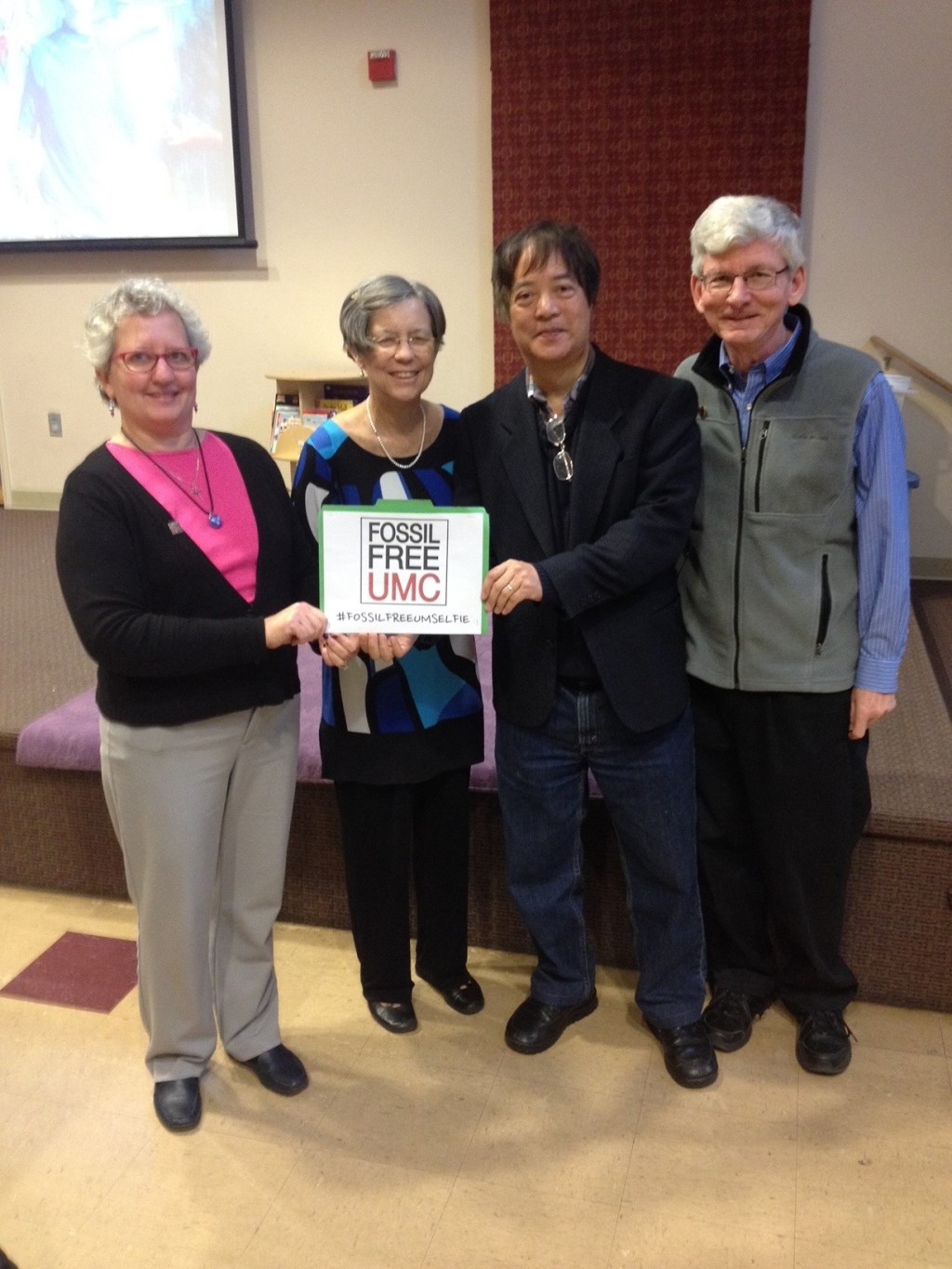
Cover photo: Pictured are three United Methodist Earthkeepers, Judy Smith, Cynthia Taylor, and Sherie Koob. Cynthia is the cochair of the Baltimore-Washington Conference delegation to General conference. Used with permission. All rights reserved.
Rev. Richenda Fairhurst is an elder in the Greater Northwest Area of the UMC, living in Southern Oregon. She volunteers with the United Methodist Creation Justice Movement and a number of other organizations at the intersection of faith and climate change. Find her at justcreation.org
Model Resolution by Sharon Delgado. Sharon Delgado is a retired UM Elder, Chair of the Cal-Nevada Climate Justice Ministries Task Force, member of the Coordinating Committee of the UM Creation Justice Movement, and Convener of Fossil Free UMC. She is author of The Cross in the Midst of Creation, Love in a Time of Climate Change, and Shaking the Gates of Hell. She blogs at sharondelgado.org.
 FossilFreeUMC
One response to “NEW: 2024 Model Divestment Legislation for Annual Conferences”
[…] legislation to your annual conference calling for your faith foundation and conference to divest. Find a model annual conference resolution here. Wespath has options now for both personal and institutional investment in fossil free funds. They […]
LikeLike