
A Cobb and Friends Presentatiowith Sharon Delgado
YouTube recording of Fossil Fuel Divestment as Climate Change Strategy, October 15, 2024.
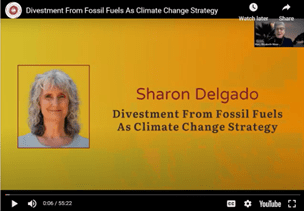
United Methodist preacher, author, and long-time climate justice activist Sharon Delgado proclaims God’s tangible presence in and through creation and the glory of a sacramental universe, but she contends that we face a reckoning as climate change advances and fossil fuel profits multiply. Will we phase out fossil fuels, as climate scientists say we must, or will the quest for profits bring about a living hell on earth?
In this presentation, Rev. Delgado, Convener of Fossil Free UMC, takes us through the steps of awakening to what is at stake as the impacts of climate change multiply. She explores the forces that perpetuate this crisis and the limitations of the dominant paradigm for climate rescue. She will point to fossil fuel divestment as a faithful response: as both a practical and symbolic way to challenge the power of the fossil fuel industry and to strengthen the global movement for climate justice.
The Reverend Sharon Delgado is a retired United Methodist pastor, author, and longtime activist and nonviolence practitioner, whose introduction to John Cobb and process theology in the 1980s helped shaped her theology and ministry. Sharon is Convener of Fossil Free UMC, which advocates for the United Methodist Church to divest from fossil fuels. She is a member of the Coordinating Committee of the United Methodist Creation Justice Movement, which works across annual conferences to coordinate actions related to creation justice. Sharon names the invisible powers that influence human behavior and that are embodied in today’s domination system, and points in the direction of both personal and social transformation. An updated Second Edition of Love in a Time of Climate Change will be released in the spring of 2025. The book is a Wesleyan approach to climate change, which uses scripture, tradition, reason, and experience to explore the issue. The inside cover of the first edition includes an endorsement by John Cobb, who wrote:
“Sharon Delgado makes it clear that we, especially we who stand in the Wesleyan tradition, cannot choose between being scriptural in the fullest sense and activity to save as much as possible from destruction through climate change. There is no tension between biblical preaching and preaching on the overwhelming, life-determining issues surrounding climate change. Let’s stop hemming and hawing and work with God to save God’s creation.”
 FossilFreeUMC
5 responses to “Fossil Fuel Divestment as Climate Change Strategy”
There will be no climate help in the US if the new EPA nomination under Trump steps in?Sad Peggy in NC
Yahoo Mail: Search, Organize, Conquer
LikeLike
Sad indeed.
LikeLike
I am glad you are circulating this presentation. It was well done.
Bill
LikeLike
Good morning from the Czech Republic, Rev. Delgado.
I attended and greatly appreciated your October presentation to “Cobb and Friends.” On that occasion, I became aware of a possibility that I really wanted to share. However, in the end, I decided that it might be too complicated to convey verbally. However, when I found this email this morning, I decided to at least mention it to you.
I have been an extension ministry in the Czech Republic for twenty-five years and have participated regularly in comprehensive recycling and excellent public transportation options that date back to the communist era–which unfortunately was also a time when major coal-mining and manufacturing processes also caused significant damage to . the environment. Presently, serious efforts to address climate change are accompanied by burgeoning numbers of cars, as well as of clothes dryers and air conditioners, which were virtually non-existent in private homes until very recently. This is to say that the response to climate change is quite ambiguous here.
That may be why I was so surprised and encouraged to read that “my” bank, which remains one of the largest banks in the country in spite of an influx of international competitors, was the FIRST BANK IN THE CZECH REPUBLIC TO DIVEST FROM COAL MINING, as part of its emerging focus on social issues and human rights. Coal mining has been a valued endeavor in some of the mountainous areas of the country, so care is being taken to ensure that new opportunities will be available for present coal miners. However, there is still strong support for coal mining among some sectors of the population. Thus, I was and am very proud of my bank for taking this action.
However, in the decision, I also see a glimmer of hope for divestment processes in the USA. I am sure that the heads of ČSOB (Czechoslovak Business Bank) knew that there was strong support for continuing to mine coal among significant sectors which might not bode well for the future of this “historic” bank, given the competative strength of
LikeLike
Oops, my original message to you accidentally got sent before I had finished or edited it, so I will try again, with apologies for the “double mailing.” Please disregard and delete the other email from me.
Good morning from the Czech Republic, Rev. Delgado.
I attended and greatly appreciated your October presentation to “Cobb and Friends.” On that occasion, I became aware of a possibility that I wanted to share, but in the end, I decided that it might be too complicated to convey verbally. However, when I read your most recent email this morning, I decided to at least mention it to you.
I have been in the Czech Republic as an extension minister from the West Ohio Conference for twenty-five years. During that time, I have participated regularly in comprehensive recycling programs and public transportation options that date back to the communist era–which unfortunately was also a time when major coal-mining and manufacturing processes also caused significant damage to the environment. Presently, serious efforts to address climate change are accompanied by burgeoning numbers of cars, as well as of clothes dryers and air conditioners, which were virtually non-existent in private homes until very recently. This means that the response to climate change is quite ambiguous here.
Thus, I was so surprised and encouraged to read that “my” bank, which remains one of the largest banks in the country in spite of an influx of international competitors, was the FIRST BANK IN THE CZECHIA TO DIVEST FROM COAL MINING, as part of its emerging focus on social issues and human rights. Coal mining has been a valued endeavor and the main employer in some mountainous areas of the country. Thus, while care is being taken to ensure that new opportunities will be available for present coal miners, there is still strong support for coal mining among some sectors of the population. Thus, I was, and am, very proud of my bank for taking this action.
Furthermore, in this decision, I see a glimmer of hope for divestment movements in the USA. Given the strength of some of its new competitors, I am sure that the heads of ČSOB (Czechoslovak Commercial Bank) knew that strong support for continuing to mine coal among significant sectors that might not bode well for its future. Thus, I am inclined to conclude that there is a large enough group of persons who support divestment that ČSOB dared to take this step, trusting that this important action would appeal to many current customers and attract a number of new ones.
This interpretation of present developments here has led me to wonder if one way of fostering divestment from fossil fuels in the USA might be to introduce both large and small banks to the possibility that divestment from fossil fuels will demonstrate a critical commitment to preserving life on earth, which will both preserve and add to its customer base. Since the new government in the USA may be disinclined to pursue policies of creation care, some powerful businesses like banks may become more amenable to joining ČSOB in standing up for climate justice at this critical juncture.
Thank you for taking time from your important work to read this overly long message. With humble respect and gratitude, Joyce Michael
LikeLike