Watch the Summit Here
See the various speakers at the following times on the video, or find the separate presentations at the YouTube link above: 00:00 – Intro 2:51 – Bishop Sandra K. Olewine 11:55 – William Morris 1:25:47 – Jim Antal 2:12:26 – Jake Barnett 2:36:31 – Julia Frisbie 3:04:00 – Daniel Cohn
“The core business of oil and gas companies is to extract, refine, and deliver oil and gas. Asking oil and gas companies to give up oil and gas is like asking United Methodists to stop worshipping God.”
A growing majority of people of faith are reclaiming biblical and faithful creation justice teaching for the church. This teaching is based in the deepest and most enduring traditions of our faith: to love one’s neighbor and love God.
In March, the California-Nevada Conference organized a Fossil Fuel Divestment Summit. Over two days, at the in-person in Sacramento, and online over zoom, summit attendees zeroed in on the moral and financial questions of fossil fuel divestment.
(Read also about the Summit from UM News: Conference Moves Toward Divestment.)
Bishop Sandra Olewine of the California-Nevada Conference signaled her support of the conversation by not only being present, but actively listening. The bishop joined all the presentations and asked questions of all the speakers in follow up. Members of the Cabinet also attended, including staff and District Superintendents, joining in with conference board and agency leaders, clergy, lay leaders, and local church members.
The idea of the Fossil Fuel Divestment Summit started with annual conference legislation. California-Nevada Conference Climate Justice Ministries Taskforce leaders submitted legislation that tasked the Conference Council on Finance and Administration to engage in real conversation around the topic. The goal was clear, to explore the feasibility of divestment by the conference and also by its boards and agencies.
For Rev. Sharon Delgado, the Summit was an opportunity to continue and amplify the momentum of UMC divestment over the last ten years. Delgado explained the goal in straightforward terms as, “screening out fossil fuels from our investments and banking relationships at all levels of the church.” Rev. Delgado is the longtime, former leader of the California-Nevada Conference Climate Justice Ministries Taskforce and current convener of Fossil Free UMC.
The legislation passed in 2024, and there was plenty of support to help pull the event together. Organizers included members of the Council on Finance and Administration, including its chair, Rev. Burke Owens, who also served as host and facilitator for the event. The Climate Justice Ministries Taskforce also helped organize, especially the new Chair of the taskforce, and conference Caretaker Coordinator, Joan Pell. Conference staff also were essential contributors to organizing the event and ensuring things ran smoothly.
The program featured 5 speakers, beginning with Bishop Sandra Olewine whose opening prayer and remarks demonstrated the forthright nature of the robust work they were taking on.
“We acknowledge,” Olewine said in opening the Summit, “that unsustainable human activities have placed the entirety of God’s creation in peril. Further we confess that the degradation and wholesale destruction of the natural environment threatens unprecedented harm, bringing danger to human and non-human life alike.”
Bishop Olewine spoke to the potential complexities of conversation around finance and divestment. She encouraged participants to meet that challenge head-on, telling them “not to be afraid because it’s not simple, and not to run away.” She called the gathered to positive, healing action, asking, “how to turn the harm that was done into good?”
William H. Morris offered the keynote address. Morris’s work in organizing faith communities around climate issues and environmental justice has been featured in Rolling Stone and BBC. Morris grew up near refineries in formerly red-lined areas of Los Angeles county. He shared the human story–his own life experience–of the harms of fossil fuel investment.
His presentation included photos of refineries flaring methane next to daycare centers and family homes. This was what investments in fossil fuels looks like, he explained, “for the people whose air, water and land are being poisoned, those children are growing up surrounded by toxins, their parents wondering if it’s safe to open the windows, it means that these entire neighborhoods are living on edge, because you’re not ever quite sure when the next incident is going to be.”
Morris’s neighborhood is one where pipelines and methane flaring are a fact of life. Says Morris, “One of the major urban drill sites that many in the LA community are working on shutting down is located next to apartments. It’s located next to a senior care home and three public schools. If you can imagine the comically worst evil place for these things to exist, that’s oftentimes where they are.”
Author and organizer Rev. Jim Antal also spoke. He attended over zoom with words of moral clarity. He spoke to the ethical and financial problems of fossil fuel investments, even when the hope is to “engage” with the company to try to get them to do better. Says Antal, “shareholder activism can and has made a difference when a company has a flaw in their business plan that violates moral norms and needs to be corrected. But shareholder activism cannot succeed when the flaw is the business plan of the company or industry.”
During Q&A, Antal also addressed the concerns often raised about “fiduciary responsibility” for investment managers. As part of his answer to that concern, Antal credited and paraphrased the conclusions of Reagan appointee Bevis Longstreath, saying, “it was fiduciarily irresponsible to remain invested in fossil fuel stocks because, if the product is simply used the way it is intended, it kills the investor.”
Perhaps the most inspired talk came from Julia Frisbie who brought a case study that brightened the room. Frisbie is the Executive Director of Faith Foundation Northwest, the UMC Foundation that serves the Greater Northwest Area of The United Methodist Church. In 2016, 2023, and 2024, two annual conferences in the Greater Northwest Area passed legislation calling for divestment options for pensions, churches, and conferences. As a result, Faith Foundation Northwest worked with Wespath to develop fossil free funds for institutional investors.
Frisbie shared that the Wespath managed fossil free funds, called the Social Values Choice Funds, available at the foundation are a leading performer in their portfolio. They have also attracted significant money to the foundation. “The benefit was so much bigger than I had imagined it might be,” says Frisbie. “Seven out of nine of our brand new congregational customers went straight into the fossil free funds…. We had more than $12.8 million dollars of new money flow in… and it just keeps coming. We had a great return.”
The establishment of the funds and the buzz surrounding the divestment effort has meant that at the time of the Summit, says Frisbie, “the balance of our holdings just tipped.” Faith Foundation Northwest’s fossil free holdings now comprise the majority of their funds. Frisbie’s charts are encouraging as they track the lines of growth, “This is unprecedented growth for us, and it’s been really exciting to see.”
Frisbie’s enthusiasm was contagious. She explained that consumer and faith-investment interest in fossil free funds weren’t just coming from Methodists, explaining, “this is global.” She spoke to good management and messaging strategies, also, such as giving fossil free, sustainable funds a more prominent place on the foundation website. “We floated them to the top of the website, because we want to lead with our best returning portfolios rather than our worst returning portfolio. We are going to flip them to the top.”
Jake Barnett is the Managing Director of Sustainable Investment Strategies at Wespath, and also a commissioned United Methodist EarthKeeper. (You will find him listed on the Wespath page, scroll to the bottom to the Sustainable Investments section.) Barnett represented Wespath, which is a United Methodist Agency, at the Summit. He affirmed that Wespath is committed to continued development and support of fossil free investment through their Social Values Choice Funds. Wespath has also committed to improving investment screens and management options.
Wespath is known to be a proponent of “engagement” with oil and gas companies and not divestment. All the same, as a United Methodist Agency, Wespath has tremendous experience working with moral screens, which include weeding out tobacco and weapons investments. In response to investor concerns about fossil fuels, last year Wespath made several new commitments to more actively support fossil fuel divestment for their customers.
One new funds management promise was the announcement that Wespath will allow Social Values investors to enroll in the Lifestage pension management option. Currently, although Lifestage is the choice of 80% of Wespath customers, the benefit is only available for customers invested in Wespath’s oil and gas funds. This change is set to take effect in 2026.
Barnett shared also that a small, dynamic firm, Xponance, is Wespath’s new Social Values Choice Funds manager. The choice, says Barnett, was a “values aligned” decision that also “made sense from a practical standpoint.” With excellent management experience at both Wespath and Xponance, Wespath, Barnett explained, will be “partnering with them to design what their positive environmental, social and governance integration looks like.”
New investor opportunities and relationships at Wespath come directly out of a continued interest in sustainable investment from United Methodists. Barnett is embracing that, saying, “So this is for us a continuing evolution of, how do we partner? How do we offer this more effectively? How do we strengthen it [sustainable investing] for the denomination?”
The final speaker, Dan Cohn, is an Energy Finance Analyst with IEEFA (Institute for Energy Economics and Finance Analysis). IEEFA is nonpartisan and global, specializing in market-based investment analysis, including with large pension managers. Cohn’s presentation brought a forthright look at the performance of fossil fuel investments over decades, as well as the current outlook of those investments now.
The take-aways from Cohn’s talk were instructive and succinct. Cohn’s talk showed the challenges facing fossil fuel companies. His assessment was that not only do fossil fuels “face a negative long-term outlook,” but “fossil fuels have already financially underperformed for years.” This outlook was based on a few factors, including historic performance, increased commercial competition, and an “apparent ambivalence about diversification in light of the long-term risks facing their business.”
For funds managers, risk assessments matter and risk is a key investment consideration. Says Cohn, “There is really good legal precedent in the US that says when a financial risk becomes known, it must be addressed with financial action. And in our view, fossil fuels rise to that level of risk and the exposure demands investigation, deliberation, and response.”
There is also good legal support, through Uniform State Laws, for institutions seeking to align their investments with their core mission and values. Cohn shared pertinent language from that law, “in making decisions about whether to acquire or attain an asset, the institution should consider the institution’s mission, its current programs, in addition to factors related more directly to the assets potential as an investment.”
The final component of the Divestment Summit happened when all the presentations were done, lunch was finished, and people had the opportunity to stretch and share thoughts together. In true Wesleyan fashion, in-person attendees drew together around tables, shared ideas and hopes, and asked further questions of the presenters.
Rev. Burke Owens facilitated the final conversation, which culminated in an agreement to take action toward divestment. A resolution was drafted and will go before the annual conference body to that effect.
Summit Hopes
For Rev. Delgado, the success of the Summit so specifically centered on divestment was cause for celebration. ““I am thrilled that the Summit went so well. The speakers were knowledgeable and spoke clearly about the moral and financial aspects of fossil fuel divestment. I’m sure it was reassuring for fund managers to learn not only that divestment was a responsible step, but also that they could divest from fossil fuels while staying with Wespath by investing in Wespath’s Social Values Choice Funds.”
The California-Nevada Divestment Summit was held March 26-27 at the conference offices in Sacramento, California. View the zoom recording here.
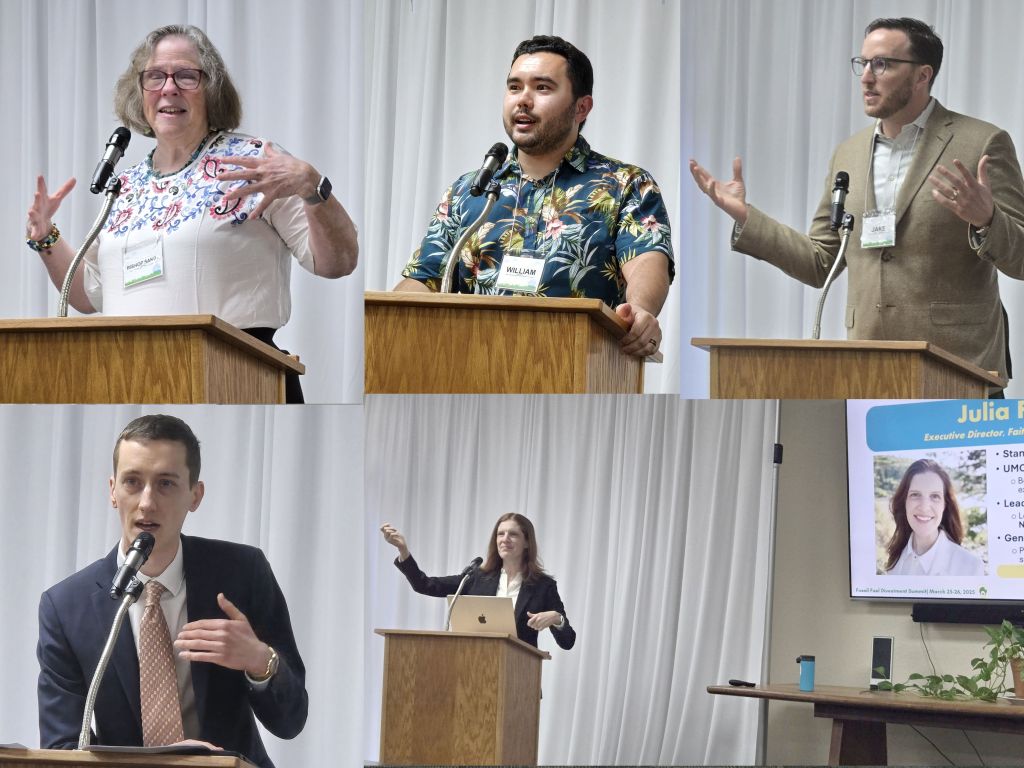
Cover Image features the in-person speakers for the California-Nevada Divestment Summit, left to right, top: Bishop Sandra Olewine, Episcopal Leader of the California-Nevada Annual Conference; William H. Morris, International Faith-Based Organizer; Jake Barnett, Managing Director of Sustainable Investment Strategies at Wespath; left to right, bottom: Dan Cohn, Energy Analyst at IEEFA, and Julia Frisbie, Executive Director at Faith Foundation Northwest. Photos and compilation by Richenda Fairhurst.
Rev. Jim Antal, Author, Activist, and Special Advisor on Climate Justice to the General Minister and President of the United Church of Christ, presented over zoom.
Article also published by the United Methodist Creation Justice Movement.
Rev. Richenda Fairhurst is here for the friendship and conversations about climate, community, and connection. For more conversations, see the team at the United Methodist Creation Justice Movement Café. Find Richenda in Southern Oregon and at JustCreation.org.
Note: I had the opportunity to attend the California-Nevada Summit in person. While I was there I had two roles, one as a member of Fossil Free UMC and the United Methodist Creation Justice Movement, the other as faithful reporter of what occurred. My hope is that this article is a faithful report of that good effort.

