Image used with permission, World Resources Institute, Creative Commons.
The Fierce Urgency of Now in Response to Climate Change
“See, now is the acceptable time; see, now is the day of salvation!” — 2 Corinthians 6:2
“We have also come to this hallowed spot to remind America of the fierce urgency of Now. This is no time to engage in the luxury of cooling off or to take the tranquilizing drug of gradualism… Now is the time to make justice a reality for all of God’s children.” Martin Luther King, I Have a Dream, 1963
The United Methodist Church has been passing resolutions, speaking out, and promoting creation care and climate action for almost fifty years. At the 1980 General Conference, we became the first denomination to call for the church and the nations of the world to shift away from fossil fuels toward conservation and renewable power. In 1992 I was part of the United Methodist delegation to Rio de Janeiro during the first global climate conference, the United Nations Conference on Environment and Development, where the Framework Convention on Climate Change was signed. It seemed that the time had come when the world would finally begin to gradually transition away from fossil fuels toward renewables and work together on sustainable development for poor nations.
In 2015, another high point, the nations of the world agreed in Paris at COP 21to work together to limit the overall rise in average temperatures to 1.5°C or well below 2°C to prevent runaway global warming caused by feedback loops. At the time, scientists said that to limit temperature rise to 1.5°C would require cutting greenhouse gas emissions by 45 percent by 2030 as an interim step toward cutting emissions to net zero by 2050. In response, many organizations pledged to reduce their own emissions to net zero by 2050, including the general agencies and Council of Bishops of the United Methodist Church.
Yet instead of declining, emissions are rapidly increasing. More than half of all emissions have been released within the past 30 years. In other words, the burden of greenhouse gases in the atmosphere has more than doubled since the Rio conference in 1992. This means that even though the human community has known the dangers of climate change for decades, and despite the efforts of so many people and institutions to address it, we are losing ground. This calls for urgent and decisive action on a global scale.
As emissions rise and global temperatures steadily advance, the frequency and intensification of weather-related disasters increase on every continent. While wealthy nations are responsible for the bulk of historical emissions, poor and marginalized countries suffer the most severe effects. Rising temperatures and weather extremes counteract efforts to reduce poverty, including in the very regions where our churches reach out in mission to provide relief from suffering. People in poor regions and black and brown communities are disproportionately impacted by fossil fuel pollution and climate disasters. These disproportionate impacts provide a key rationale for calls for climate justice, which focuses on immediately phasing out fossil fuels and providing “loss and damage” payments to those most impacted.
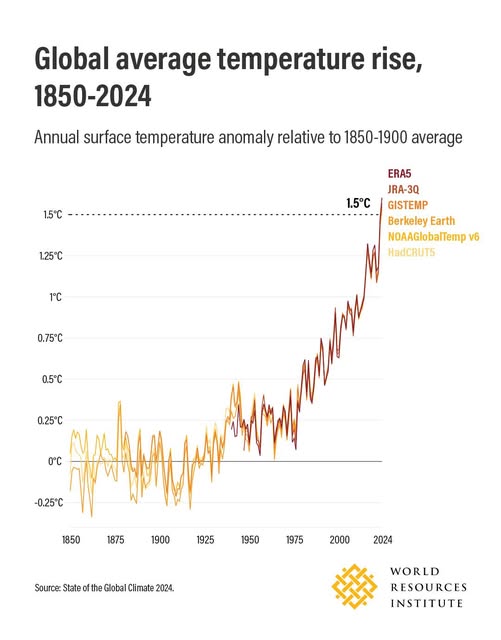
Meanwhile, since 2023 average global temperatures have spiked, alarming scientists. Global temperatures are now hovering around 1.5°C, the lower limit of the Paris Agreement. The whole point of the goal of “net zero by 2050” was to limit overall warming to no more than 1.5°C or well below 2°C, and we are on the brink of shooting past those limits. Section B-6 of the most recent report of the Intergovernmental Panel on Climate Change makes clear the need for urgent climate action, and describes what that will take: “All global modelled pathways that limit warming to 1.5°C . . . and those that limit warming to 2°C . . . involve rapid and deep and, in most cases, immediate greenhouse gas emissions reductions in all sectors this decade.” The report also highlights the scientific basis that proves the urgency of phasing out fossil fuels, the primary driver of climate change. This need to phase out fossil fuels is the basis for Fossil Free UMC’S call for our church to divest from fossil fuels. Deep cuts in emissions are needed in this decade, starting now.
Scientists warn that we face a perilous moment of choice. The window of time to stabilize the climate still stands open, but if we continue along the current path, it will soon slam shut. The United Methodist Church has a part to play in raising the alarm, and was the first denomination to do so. Today we have the opportunity and, based on our previous commitments, the responsibility to strengthen that call and to model a faithful response to the climate emergency.
The light of Christ points us in the direction of a brighter future (powered by the sun!) that we can live into beginning now. However, as the planet rapidly warms, the challenge of acting now for climate justice becomes clearer as we face the existential urgency of this moment. “See, now is the acceptable time; see, now is the day of salvation!”
Today, Martin Luther King, Jr.’s prophetic reminder of “the fierce urgency of now” can be applied as a critique to our attempts to use a soft, gradual, non-controversial approach to addressing climate change. A gradual approach might have worked beginning in 1980, or 1992, or even in 2015. But the time for gradualism has passed. Now is the time to make justice, including climate justice, a reality for all of God’s children, and for all of God’s creation.
The next two posts will be sequels to this blog post. Blocks to Strong Climate Action and A Merciful, Just, and Proportional Response to Climate Change. (coming soon).
You might also enjoy Sharon’s Lenten blog series, Spiritual Foundations for Nonviolent Resistance to Empire, along with information about my books and presentation topics. Contact me here.
The Reverend Sharon Delgado is the Convener of Fossil Free UMC, which advocates for the United Methodist Church to divest from fossil fuels, and is on the Coordinating Committee of the United Methodist Creation Justice Movement. The revised edition of her book Love in a Time of Climate Change was released in January 2026 and is available now. Sharon’s other writings and information about her books and presentations can be found at sharondelgado.org.
 FossilFreeUMC
2 responses to “The Fierce Urgency of Now in Response to Climate Change”
Excellent update. I’m proud to be a part of the FFUMC and appreciate your leadership.
LikeLike
Thank you, Rev Delgado, for your leadership thru the years & decades. You’re an example for all UM’s to follow.
LikeLike