By Sharon Delgado
“Where your treasure is, there your heart will be also.” (Matthew 6:21).
In the above passage, Jesus tells us to value spiritual treasures above our material treasures. This passage also reminds us that how we use or invest our material treasures expresses our spiritual values, for “where your treasure is, there your heart will be also.”
These words are especially relevant in the context of our rapidly heating planet. We United Methodists have a heart for God’s creation and for climate justice. As I write, the US is enmeshed in a catastrophic war in with Iran that is killing countless people, wreaking havoc on the fossil-fuel-based global economy, creating massive profits for fossil fuel corporations, and multiplying deadly fossil fuel emissions. Tom Englebright writes: “So, here we are blasting the hell out of Iran and, of course, in the process, as all wars do, putting wildly more fossil fuels into the atmosphere. Modern war and preparations for them may, in fact, be the most carbon intensive activity on this ever warming planet of ours.”
As a denomination we have long acknowledged the dangers of climate change and have called for a just transition away from fossil fuels toward a clean energy future. Yet many United Methodist individuals, churches, annual conferences, and agenencies, including our Board of Pensions (Wespath), continue to invest in fossil fuels, the primary cause of climate change. Even as our treasure is tangled up with fossil fuels, the United Methodist Church has been witnessing to God’s call to care for creation. Throughout the denomination United Methodists have taken actions to “green” the church and advocate for climate justice. One important step was a denominational pledge to achieve net zero emissions by 2050.
Net Zero by 2050
In 2021, eleven United Methodist agencies came together to strengthen our denomination’s response to climate change by forming The United Methodist Interagency Just and Equitable Net Zero Coalition and joining the global effort to achieve net zero emissions by 2050. The Coalition’s statement explained why attaining net zero is important: “To keep global warming to no more than 1.5°C — as called for in the Paris Agreement — emissions need to be reduced by 45% by 2030 and reach net zero by 2050.” Other agencies and the Council of Bishops have since joined in this commitment to attain net zero within their institutions by 2050. The delegates of the 2020/2024 General Conference of The United Methodist Church affirmed this commitment, which is now part of our United Methodist Book of Resolutions.
1.5 to Stay Alive
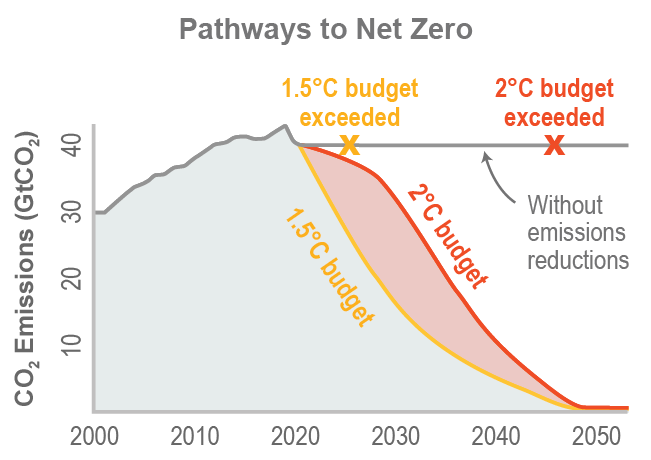
The Intergovernmental Panel on Climate Change (IPCC) has repeatedly called on the global community to stabilize the climate by limiting greenhouse gas emissions to 1.5°C (2.7°F) above pre-industrial levels “to prevent the worst impacts of climate change and preserve a livable planet.” Leading up to COP 21 in Paris in 2015, climate activists around the world seized on this goal with passion and hope, popularizing the slogan “1.5 to Stay Alive.” The IPCC has described “pathways” to achieve this goal: “To keep global warming to no more than 1.5°C — as called for in the Paris Agreement — emissions need to be reduced by 45% by 2030 and reach net zero by 2050.” The IPCC has repeatedly stressed the need to rapidly phase out oil, coal, and gas to effectively address the climate crisis. Fortunately, and not a moment too soon, the first meeting of the global Nonproliferation Treaty Coalition world will meet in Colombia beginning next week, in the attempt to coordinate and speed up this process.
Time is Running Out
But let’s be honest with ourselves: time is running out for the world to achieve the goal of “a net zero economy by 2050.” This long-term goal cannot be met without short-term goals along the way. Yet instead of being on track to reach emissions reductions of 45% by 2030, which is the only pathway to net zero by 2050, global emissions are rising year after year. Average global temperatures spiked to 1.45°C above pre-industrial levels 2023, breached 1.5°C throughout 2024, and are now hovering around the 1.5°C Paris limit. The whole point of the “net zero by 2050” movement was to stabilize the climate by limiting global temperature rise to no more than 1.5°C, yet we are hurtling past this goal. Scientists say it is still possible, but one look at the graph above shows what dramatic action reaching net zero by 2050 would take.
Where does this reality leave us with our net zero commitments as a church? Are we still hoping to meet our internal goals? Are United Methodists agencies on track to cut emissions by 45 percent by 2030? Some institutions, including some investment firms, are postponing action, hoping that unproven “Plan B” technologies like carbon capture and geoengineering technologies will progress enough in the coming years to draw down significant amounts of carbon. A more direct and safer strategy is Plan A: a fair phaseout fossil fuels and a speedy and just transition to a clean energy future, as our statements have called for. Without short term goals, commitments such as these postpone coming to terms with the the action required by the urgent and existential threat posed by climate change.
This is not the end of the struggle for climate stability or for climate justice. Every fraction of a degree of warming is significant. But it is time to redouble our efforts to cut fossil fuels in our lifestyles, churches, annual conferences, and agencies while facing the extremity of our current global situation. Emissions are rising. Fossil fuel companies are still extracting coal, oil, and gas and constructing durable infrastructure, including for data centers and for petrochemical plants for doubling or tripling plastics production that will lock us into decades of accelerating emissions. Temperatures are spiking. How shall we as United Methodists respond to this most challenging crisis humanity has ever faced? According to UN Secretary-General Antonio Guterres: “The science is clear: The 1.5°C limit is only possible if we ultimately stop burning all fossil fuels. Not reduce, not abate. Phase out, with a clear timeframe.” We need to phase out fossil fuels.
Fossil free UMC supports phasing out fossil fuels, including from our denominational investments, by “screening out fossil fuels from our investments and banking relationships at all levels of the church.” We are called to invest our material treasures where our hearts are, by “investing in goods and services that support a just transition to a clean energy future.” This seems like a positive next step for UMC net zero agencies: to divest from fossil fuels.
Because this is a critical decade and time is running out, we cannot wait until the 2028 General Conference to try to institute an overall investment screen on fossil fuels. Instead, we call on all United Methodist churches, conferences, boards, and agencies to divest from fossil fuels, beginning with the agencies that have signed the pledge to attain net zero by 2050. By doing so, we take a stand for climate justice in solidarity with vulnerable communities that are most impacted by climate change and strengthen the global movement to phase out fossil fuels.
Sharon Delgado is a preacher, activist, author, and Convener of Fossil Free UMC. The updated Second Edition of her book, Love in a Time of Climate Change: Honoring Creation, Establishing Justice, is now available.
Divesting from fossil fuel corporations would eliminate Scope 3 greenhouse gas emissions, and help the agencies reach net zero. One way to do this is by contacting Wespath or your United Methodist faith foundation, and directing them to move your funds into Wespath’s low-carbon, socially responsible, Social Values Choice investment portfolios.

